
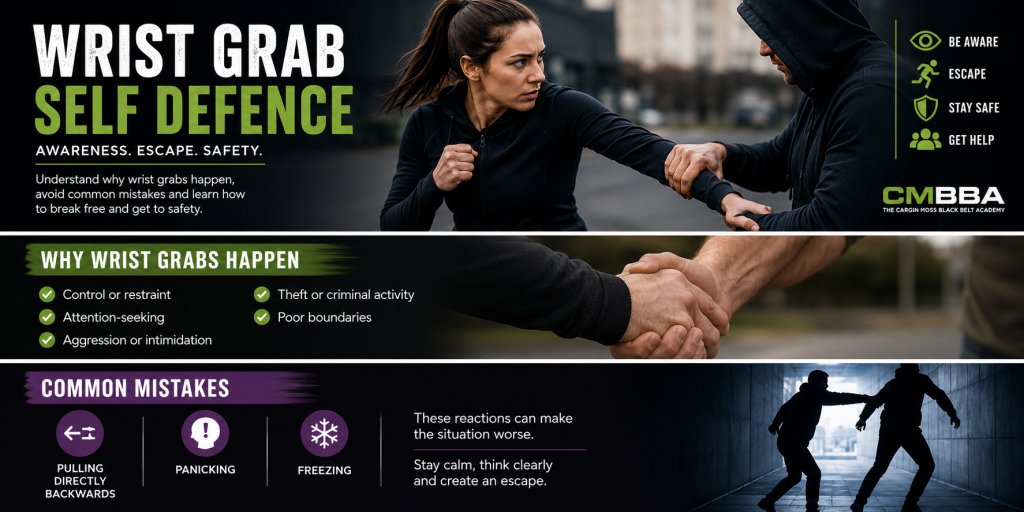
Being grabbed by the wrist can be a sudden and unsettling experience. When people are surprised by unwanted physical contact, they often react instinctively. Unfortunately, an instinctive reaction is not always the most effective way to escape a wrist grab or stay safe.
A wrist grab can happen from the front, side or rear and may have very different intentions behind it. Someone may be trying to get your attention, prevent you from walking away, intimidate you, control your movement or escalate a confrontation.
Understanding why wrist grabs happen is an important part of learning wrist grab self defence. Before thinking about physical techniques, it is important to understand awareness, mindset and the simple objective of creating an opportunity to escape.
At CMBBA, we believe self defence begins long before physical contact. Awareness, preparation and the ability to stay calm can be just as important as the physical technique itself.
Why Do Wrist Grabs Happen?
A wrist grab does not always mean that someone intends to seriously harm you. However, unwanted physical contact should never be ignored simply because the person’s intention is unclear.
Some common reasons for a wrist grab include:
- Control or restraint: Someone may grab your wrist to stop you from leaving, walking away or taking an action.
- Attention-seeking: A person may grab your wrist because they believe they are being ignored and want to force your attention.
- Aggression or intimidation: A wrist grab can be used to assert control, threaten or frighten another person.
- Theft or criminal activity: An offender may grab a person’s wrist while attempting to steal property or prevent them from escaping.
- Poor boundaries or misjudgement: Occasionally, someone may grab another person’s wrist without understanding that the contact is inappropriate or unwanted.
The important point is that you cannot always know what will happen next.
This is why awareness matters.
Awareness Is the First Line of Personal Safety
Effective self defence does not begin with a punch, kick or escape technique.
It begins with awareness.
Being aware of your surroundings can help you recognise situations that may become uncomfortable or unsafe before physical contact occurs.
Good personal safety awareness includes:
- Paying attention to the people and situations around you.
- Trusting your instincts when something does not feel right.
- Maintaining personal space where possible.
- Identifying exits, safe locations and people who could provide assistance.
- Remaining aware of changes in someone’s behaviour or body language.
- Staying as calm as possible so you can think clearly under pressure.
You do not need to become paranoid or constantly look for danger.
Instead, the aim is to become more aware, prepared and confident.
That preparation can make a significant difference if something unexpected happens.
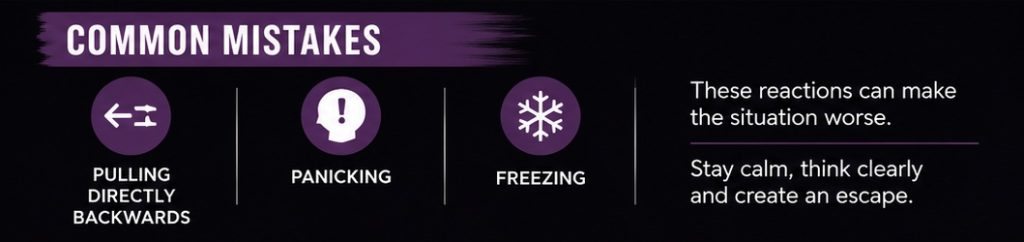
Common Mistakes When Someone Grabs Your Wrist
When a wrist grab happens unexpectedly, the body can react before the mind has had time to process what is happening.
Understanding some common reactions can help you prepare for them.
1. Pulling Directly Backwards
What people often do
One of the most natural reactions to a wrist grab is to immediately pull the arm backwards.
People may try to:
- Pull away using strength alone.
- Yank the arm repeatedly.
- Fight against the grip without thinking about positioning.
- Continue pulling even when the grip does not release.
Why this may not work
A person’s hand is designed to grip. When you pull directly against the grip, you may be working against the strongest part of the hold.
Trying to win a strength contest can also:
- Waste energy.
- Affect your balance.
- Increase frustration.
- Give the other person more opportunity to maintain control.
The better mindset
Instead of thinking:
“I need to pull harder.”
Think:
“I need to create an opportunity to break contact and escape.”
This change in mindset is important.
A wrist grab escape is not necessarily about being stronger than the person holding you. It is about understanding the situation and creating an opportunity to regain control of your movement.
2. Panicking
What people often do
A sudden wrist grab can trigger an emotional response.
Someone may:
- Panic.
- Make rushed movements.
- Lose awareness of their surroundings.
- Struggle to think clearly.
- Forget to look for help or an escape route.
If a person has never considered the possibility of being grabbed, the experience may be even more surprising.
Why panic can make things harder
When we panic, our attention can become focused entirely on the immediate problem.
That can make it harder to notice:
- Where the exit is.
- Who is nearby.
- Whether help is available.
- Where the other person’s attention is focused.
- Whether there is an opportunity to move away.
The better mindset
Stay as calm as possible and focus on your objective.
Your objective is not to defeat the person.
Your objective is to break contact, create distance and get to safety.
3. Freezing
Freezing is another common response to sudden or threatening situations.
What people may experience
A person may:
- Become temporarily unable to react.
- Hesitate because they are shocked.
- Feel confused about what to do.
- Wait for the situation to resolve itself.
Freezing is a natural stress response and does not mean that someone is weak or incapable.
However, preparation can help you respond more effectively.
The better mindset
Breathing can help you regain focus.
Remember that speaking or shouting normally happens during an outward breath. Purposeful breathing can therefore help you regain control while allowing you to communicate at the same time.
A simple verbal command such as:
“Let go!”
may also establish a boundary and attract attention.
The aim is to move from being overwhelmed by the situation to recognising your options.
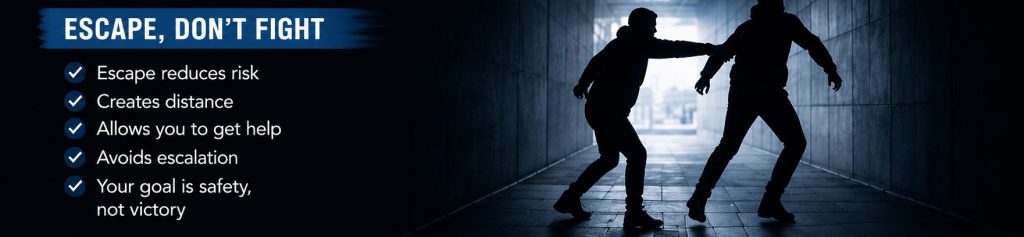
Wrist Grab Self Defence: Escape Rather Than Fight
One of the most important principles of personal safety is understanding the difference between escaping and fighting.
The primary goal of self defence should be to get to safety, not to win a fight.
If someone grabs your wrist, you do not automatically need to fight them.
Instead, consider the bigger objective:
- Recognise what is happening.
- Stay as calm as possible.
- Create an opportunity to break contact.
- Create distance.
- Move toward safety.
- Seek help if necessary.
Why escape should be the priority
Escaping can:
- Reduce the opportunity for further physical contact.
- Create distance from the threat.
- Give you an opportunity to reach other people.
- Reduce unnecessary escalation.
- Allow you to seek assistance.
Trying to physically dominate the other person introduces additional risks.
They may be:
- Stronger than you.
- Larger than you.
- More aggressive than expected.
- Accompanied by another person.
- Carrying something that could increase the danger.
This is why CMBBA teaches a self-protection mindset rather than a fighting mindset.
The objective is not:
“How do I beat this person?”
The objective is:
“How do I get free and get away safely?”
What If Physical Action Becomes Necessary?
There may be situations where a passive wrist release is not enough.
The circumstances surrounding the grab matter.
A grab could be:
- Relatively minor but unwanted.
- An attempt to control your movement.
- Part of an escalating confrontation.
- A sudden attack by an opportunist.
Your response should therefore be appropriate to the situation.
A passive escape may be the most appropriate response in one situation, while a more physical response may become necessary in another.
The principle remains the same:
Create an opportunity to escape rather than becoming committed to a fight.
Physical techniques should be trained responsibly, with safety and control as priorities.
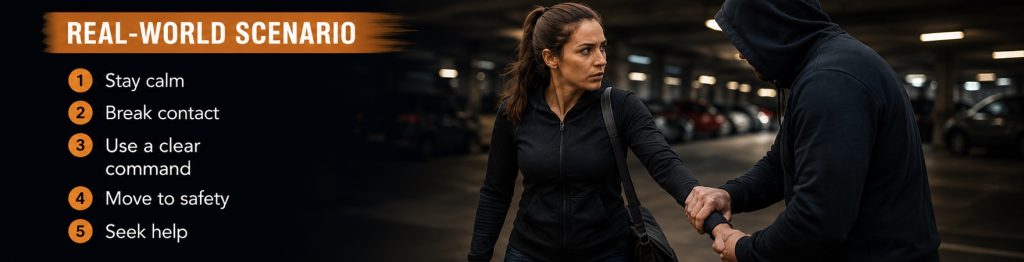
A Real-World Wrist Grab Scenario
Imagine you are walking through a car park when someone unexpectedly grabs your wrist.
You do not immediately know why.
They may be trying to get your attention, stop you from walking away or initiate a confrontation.
Rather than immediately becoming involved in a physical struggle, a safety-focused response could involve:
- Stay as calm as possible.
- Recognise that you have been grabbed.
- Look for an opportunity to break contact.
- Use a clear verbal command such as “Let go!” if appropriate.
- Create distance once free.
- Move toward a safer, more public location.
- Seek assistance from other people, security staff or the appropriate emergency services if necessary.
The objective is not to confront the person.
The objective is to remove yourself from danger.
Why Timing and Commitment Matter
One important lesson when learning how to escape a wrist grab is that simply knowing a technique is not enough.
A technique needs to be practised.
The CMBBA approach is based on learning a movement correctly, repeating it and developing enough familiarity that you can perform it with greater confidence.
When someone grabs your wrist, repeatedly making half-hearted movements may not create the opportunity you need.
A decisive, committed response—appropriate to the situation—can be more effective than repeatedly struggling against the grip.
However, commitment does not mean aggression.
It means understanding your objective and acting decisively to create an opportunity to escape.
Evasion Gives You Back Control
When someone grabs your wrist, they have temporarily restricted your movement.
Your goal is to regain control.
That does not necessarily mean controlling the other person.
It means controlling your own ability to move away.
Once you have created an opportunity to break contact, evasion and distance become important.
Getting away can allow you to:
- Reach other people.
- Move toward a safer location.
- Call for assistance.
- Assess what is happening.
- Avoid further physical contact.
This is one of the most important principles of personal safety and self defence:
You do not have to win the confrontation to successfully protect yourself.
You need to create an opportunity to get away.
Safety First
Whenever you are dealing with unwanted physical contact, safety should remain the priority.
Remember to:
- Prioritise escape rather than confrontation.
- Use a simple passive wrist release when appropriate and when you have been trained to do so.
- Be prepared to respond appropriately if the situation escalates.
- Use your voice to establish boundaries and attract attention when appropriate.
- Move toward populated, well-lit areas where possible.
- Seek help from other people, security staff or the appropriate emergency services if you feel threatened.
- Report incidents involving assault, harassment or criminal behaviour where appropriate.
There is no single response that is right for every situation.
The circumstances, environment and behaviour of the other person all matter.
Bonus: Passive Wrist Grab Release
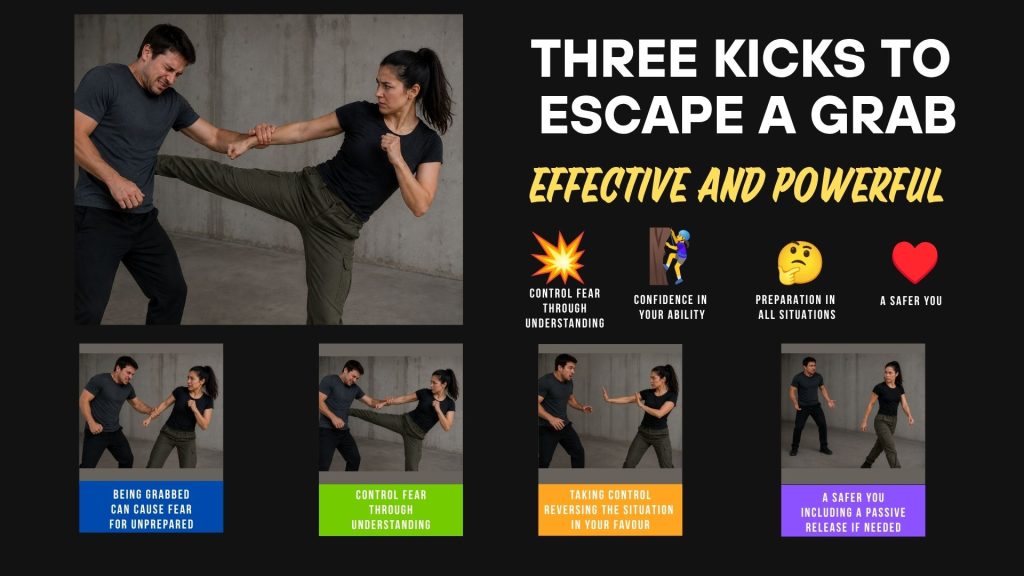
The three-kick principles taught within this mini-course are designed to give you practical options for creating an opportunity to escape.
However, they are not the solution to every situation.
There are circumstances where using kicks or strikes may be inappropriate.
For example:
- You may be at work or school.
- The person may be someone you know and you do not want to injure them.
- The situation may be relatively minor and a less aggressive response may be sufficient.
- The environment may make a physical response inappropriate.
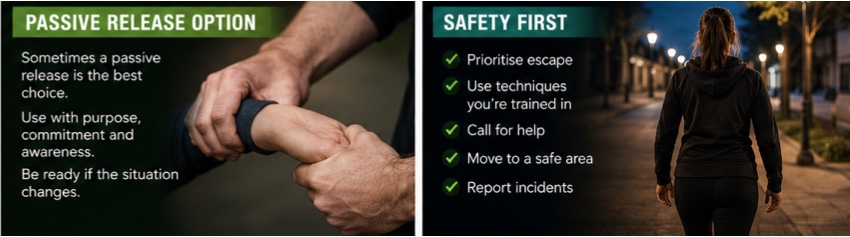
In these situations, a passive wrist release may provide another option.
However, passive does not mean careless.
If you need to release a wrist grab, the movement should still be performed with purpose, commitment and urgency.
And importantly, you should remain aware of what happens next.
If the other person’s behaviour changes and the situation becomes more threatening, your priority may need to change from passive release to creating a greater opportunity to escape.
Why Understanding Wrist Grabs Matters
A wrist grab can seem simple, but the situation surrounding it can be complicated.
The important lesson is not simply learning how to pull your wrist free.
It is learning how to recognise the situation, manage your response and create an opportunity to escape.
The most useful mindset is:
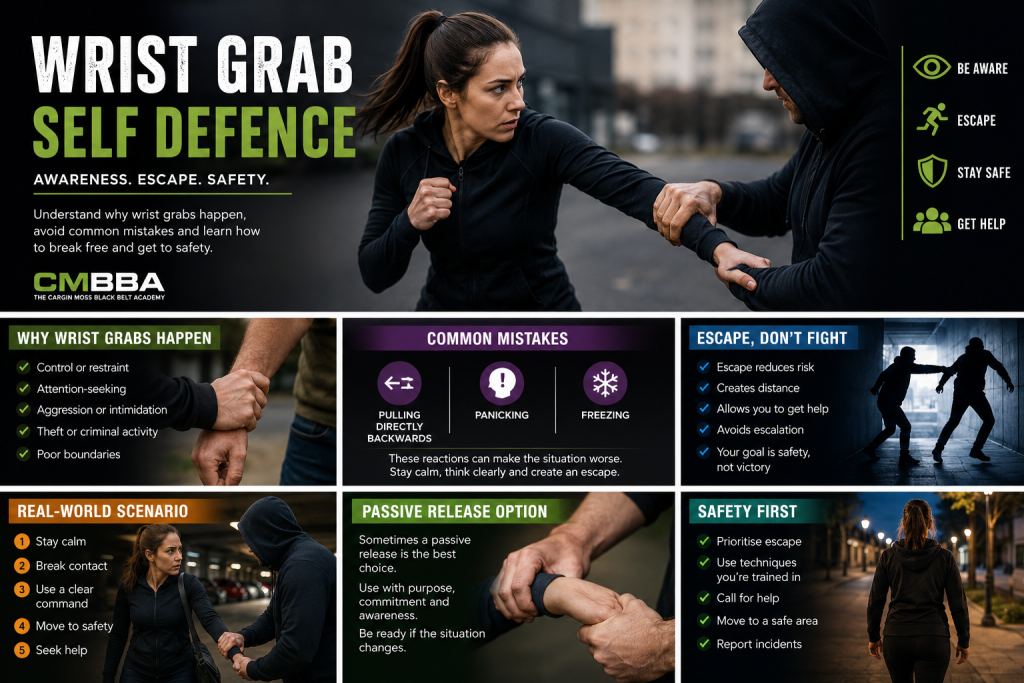
Awareness → Action → Escape → Safety
You do not need to become a fighter to become more confident in your personal safety.
You need to understand your options.
Key Takeaway
Wrist grabs can happen for many different reasons, including attention-seeking, control, intimidation, criminal activity or poor judgement.
Whatever the reason, your first priority should be your safety.
Rather than automatically pulling harder, panicking or freezing, learn to recognise the situation, stay as calm as possible and look for an opportunity to break contact.
The goal of self defence is not to win a fight. The goal is to create an opportunity to get free, create distance and get to safety.
That is the mindset behind CMBBA training.
Learn the technique. Practise the technique. Build confidence in your ability to respond.
Because when something unexpected happens, preparation can make the difference between simply reacting and knowing what to do.
Want to Learn How to Escape a Wrist Grab??
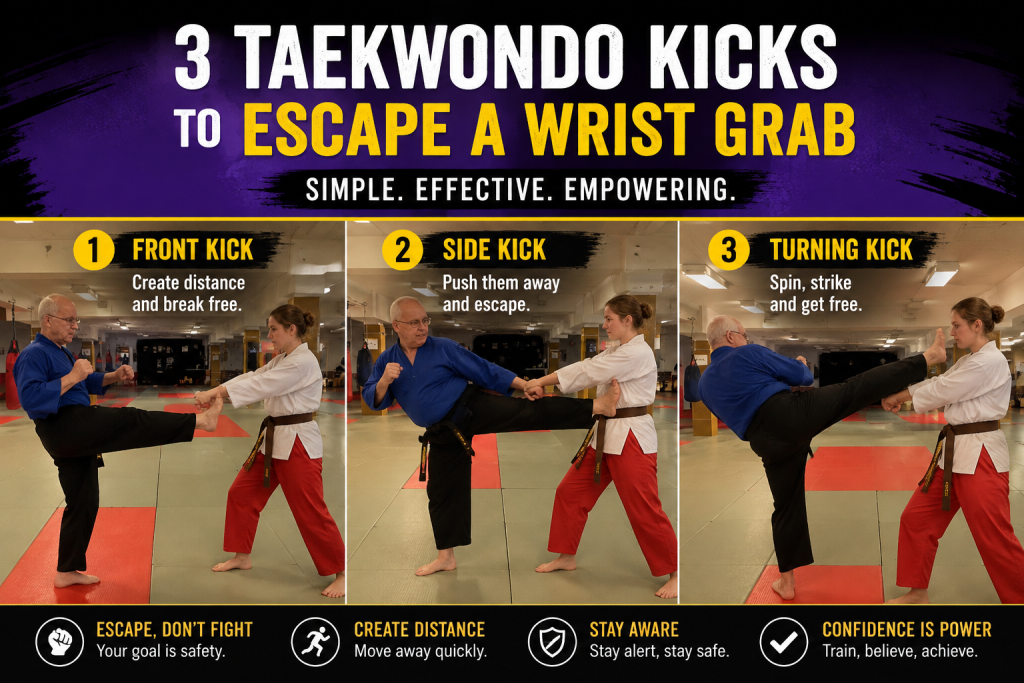
The CMBBA Three Kicks to Escape a Wrist Grab mini-course takes you through practical techniques designed to help you understand what to do if someone grabs your wrist.
You will learn the Front Kick, Side Kick and Turning Kick, along with a passive wrist release for situations where a less aggressive response may be appropriate.
Don’t just watch a technique. Learn it, practise it and build confidence in your ability to respond.
Click this link to get immediately access 👉