Tag: Practical Steps to Build Discipline in Your Career

  • Why Wrist Grabs Happen: Understanding Wrist Grab Self Defence

    Why Wrist Grabs Happen: Understanding Wrist Grab Self Defence

    Why Wrist Grabs Happen: Understanding Wrist Grab Self Defence

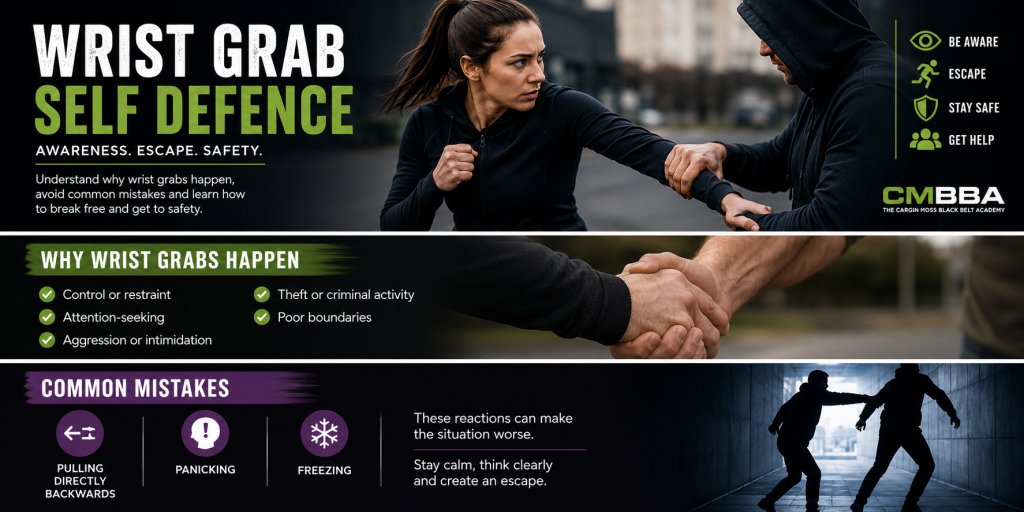
    Being grabbed by the wrist can be a sudden and unsettling experience. When people are surprised by unwanted physical contact, they often react instinctively. Unfortunately, an instinctive reaction is not always the most effective way to escape a wrist grab or stay safe.

    A wrist grab can happen from the front, side or rear and may have very different intentions behind it. Someone may be trying to get your attention, prevent you from walking away, intimidate you, control your movement or escalate a confrontation.

    Understanding why wrist grabs happen is an important part of learning wrist grab self defence. Before thinking about physical techniques, it is important to understand awareness, mindset and the simple objective of creating an opportunity to escape.

    At CMBBA, we believe self defence begins long before physical contact. Awareness, preparation and the ability to stay calm can be just as important as the physical technique itself.

    Why Do Wrist Grabs Happen?

    A wrist grab does not always mean that someone intends to seriously harm you. However, unwanted physical contact should never be ignored simply because the person’s intention is unclear.

    Some common reasons for a wrist grab include:

    • Control or restraint: Someone may grab your wrist to stop you from leaving, walking away or taking an action.
    • Attention-seeking: A person may grab your wrist because they believe they are being ignored and want to force your attention.
    • Aggression or intimidation: A wrist grab can be used to assert control, threaten or frighten another person.
    • Theft or criminal activity: An offender may grab a person’s wrist while attempting to steal property or prevent them from escaping.
    • Poor boundaries or misjudgement: Occasionally, someone may grab another person’s wrist without understanding that the contact is inappropriate or unwanted.

    The important point is that you cannot always know what will happen next.

    This is why awareness matters.

    Awareness Is the First Line of Personal Safety

    Effective self defence does not begin with a punch, kick or escape technique.

    It begins with awareness.

    Being aware of your surroundings can help you recognise situations that may become uncomfortable or unsafe before physical contact occurs.

    Good personal safety awareness includes:

    • Paying attention to the people and situations around you.
    • Trusting your instincts when something does not feel right.
    • Maintaining personal space where possible.
    • Identifying exits, safe locations and people who could provide assistance.
    • Remaining aware of changes in someone’s behaviour or body language.
    • Staying as calm as possible so you can think clearly under pressure.

    You do not need to become paranoid or constantly look for danger.

    Instead, the aim is to become more aware, prepared and confident.

    That preparation can make a significant difference if something unexpected happens.
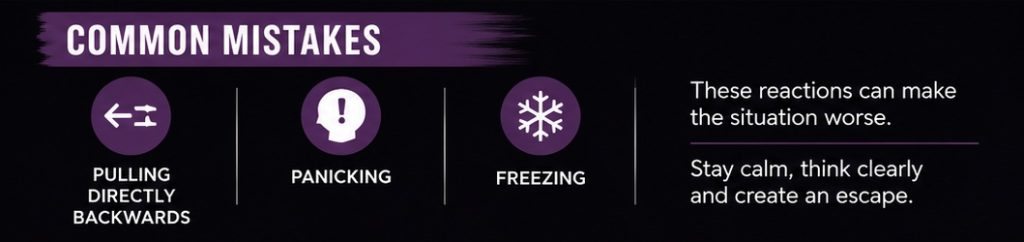
    common mistakes is trying to just pull away using strength alone,
repeatedly trying to do the pull away, or trying to release from an ever tightening grab
    Screenshot

    Common Mistakes When Someone Grabs Your Wrist

    When a wrist grab happens unexpectedly, the body can react before the mind has had time to process what is happening.

    Understanding some common reactions can help you prepare for them.

    1. Pulling Directly Backwards

    What people often do

    One of the most natural reactions to a wrist grab is to immediately pull the arm backwards.

    People may try to:

    • Pull away using strength alone.
    • Yank the arm repeatedly.
    • Fight against the grip without thinking about positioning.
    • Continue pulling even when the grip does not release.

    Why this may not work

    A person’s hand is designed to grip. When you pull directly against the grip, you may be working against the strongest part of the hold.

    Trying to win a strength contest can also:

    • Waste energy.
    • Affect your balance.
    • Increase frustration.
    • Give the other person more opportunity to maintain control.

    The better mindset

    Instead of thinking:

    “I need to pull harder.”

    Think:

    “I need to create an opportunity to break contact and escape.”

    This change in mindset is important.

    A wrist grab escape is not necessarily about being stronger than the person holding you. It is about understanding the situation and creating an opportunity to regain control of your movement.

    2. Panicking

    What people often do

    A sudden wrist grab can trigger an emotional response.

    Someone may:

    • Panic.
    • Make rushed movements.
    • Lose awareness of their surroundings.
    • Struggle to think clearly.
    • Forget to look for help or an escape route.

    If a person has never considered the possibility of being grabbed, the experience may be even more surprising.

    Why panic can make things harder

    When we panic, our attention can become focused entirely on the immediate problem.

    That can make it harder to notice:

    • Where the exit is.
    • Who is nearby.
    • Whether help is available.
    • Where the other person’s attention is focused.
    • Whether there is an opportunity to move away.

    The better mindset

    Stay as calm as possible and focus on your objective.

    Your objective is not to defeat the person.

    Your objective is to break contact, create distance and get to safety.

    3. Freezing

    Freezing is another common response to sudden or threatening situations.

    What people may experience

    A person may:

    • Become temporarily unable to react.
    • Hesitate because they are shocked.
    • Feel confused about what to do.
    • Wait for the situation to resolve itself.

    Freezing is a natural stress response and does not mean that someone is weak or incapable.

    However, preparation can help you respond more effectively.

    The better mindset

    Breathing can help you regain focus.

    Remember that speaking or shouting normally happens during an outward breath. Purposeful breathing can therefore help you regain control while allowing you to communicate at the same time.

    A simple verbal command such as:

    “Let go!”

    may also establish a boundary and attract attention.

    The aim is to move from being overwhelmed by the situation to recognising your options.
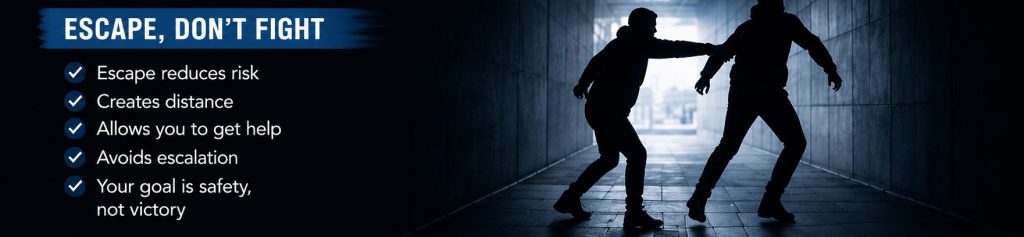
    escape and don't fight is an important first line of this defence concept
    Screenshot

    Wrist Grab Self Defence: Escape Rather Than Fight

    One of the most important principles of personal safety is understanding the difference between escaping and fighting.

    The primary goal of self defence should be to get to safety, not to win a fight.

    If someone grabs your wrist, you do not automatically need to fight them.

    Instead, consider the bigger objective:

    1. Recognise what is happening.
    2. Stay as calm as possible.
    3. Create an opportunity to break contact.
    4. Create distance.
    5. Move toward safety.
    6. Seek help if necessary.

    Why escape should be the priority

    Escaping can:

    • Reduce the opportunity for further physical contact.
    • Create distance from the threat.
    • Give you an opportunity to reach other people.
    • Reduce unnecessary escalation.
    • Allow you to seek assistance.

    Trying to physically dominate the other person introduces additional risks.

    They may be:

    • Stronger than you.
    • Larger than you.
    • More aggressive than expected.
    • Accompanied by another person.
    • Carrying something that could increase the danger.

    This is why CMBBA teaches a self-protection mindset rather than a fighting mindset.

    The objective is not:

    “How do I beat this person?”

    The objective is:

    “How do I get free and get away safely?”

    What If Physical Action Becomes Necessary?

    There may be situations where a passive wrist release is not enough.

    The circumstances surrounding the grab matter.

    A grab could be:

    • Relatively minor but unwanted.
    • An attempt to control your movement.
    • Part of an escalating confrontation.
    • A sudden attack by an opportunist.

    Your response should therefore be appropriate to the situation.

    A passive escape may be the most appropriate response in one situation, while a more physical response may become necessary in another.

    The principle remains the same:

    Create an opportunity to escape rather than becoming committed to a fight.

    Physical techniques should be trained responsibly, with safety and control as priorities.

    Screenshot

    A Real-World Wrist Grab Scenario

    Imagine you are walking through a car park when someone unexpectedly grabs your wrist.

    You do not immediately know why.

    They may be trying to get your attention, stop you from walking away or initiate a confrontation.

    Rather than immediately becoming involved in a physical struggle, a safety-focused response could involve:

    1. Stay as calm as possible.
    2. Recognise that you have been grabbed.
    3. Look for an opportunity to break contact.
    4. Use a clear verbal command such as “Let go!” if appropriate.
    5. Create distance once free.
    6. Move toward a safer, more public location.
    7. Seek assistance from other people, security staff or the appropriate emergency services if necessary.

    The objective is not to confront the person.

    The objective is to remove yourself from danger.
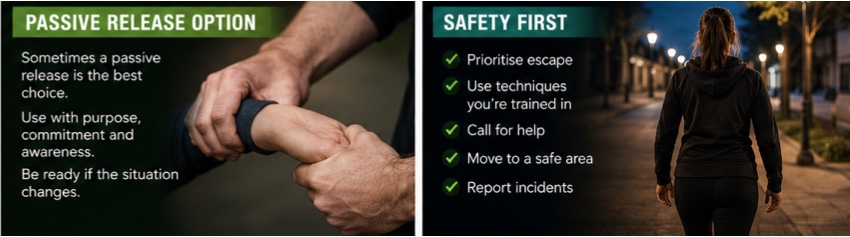
    passive release option is import as it can finish the situation straight away and think safety first
    Screenshot

    Why Timing and Commitment Matter

    One important lesson when learning how to escape a wrist grab is that simply knowing a technique is not enough.

    A technique needs to be practised.

    The CMBBA approach is based on learning a movement correctly, repeating it and developing enough familiarity that you can perform it with greater confidence.

    When someone grabs your wrist, repeatedly making half-hearted movements may not create the opportunity you need.

    A decisive, committed response—appropriate to the situation—can be more effective than repeatedly struggling against the grip.

    However, commitment does not mean aggression.

    It means understanding your objective and acting decisively to create an opportunity to escape.

    Evasion Gives You Back Control

    When someone grabs your wrist, they have temporarily restricted your movement.

    Your goal is to regain control.

    That does not necessarily mean controlling the other person.

    It means controlling your own ability to move away.

    Once you have created an opportunity to break contact, evasion and distance become important.

    Getting away can allow you to:

    • Reach other people.
    • Move toward a safer location.
    • Call for assistance.
    • Assess what is happening.
    • Avoid further physical contact.

    This is one of the most important principles of personal safety and self defence:

    You do not have to win the confrontation to successfully protect yourself.

    You need to create an opportunity to get away.

    Safety First

    Whenever you are dealing with unwanted physical contact, safety should remain the priority.

    Remember to:

    • Prioritise escape rather than confrontation.
    • Use a simple passive wrist release when appropriate and when you have been trained to do so.
    • Be prepared to respond appropriately if the situation escalates.
    • Use your voice to establish boundaries and attract attention when appropriate.
    • Move toward populated, well-lit areas where possible.
    • Seek help from other people, security staff or the appropriate emergency services if you feel threatened.
    • Report incidents involving assault, harassment or criminal behaviour where appropriate.

    There is no single response that is right for every situation.

    The circumstances, environment and behaviour of the other person all matter.

    Bonus: Passive Wrist Grab Release

    The three-kick principles taught within this mini-course are designed to give you practical options for creating an opportunity to escape.

    However, they are not the solution to every situation.

    There are circumstances where using kicks or strikes may be inappropriate.

    For example:

    • You may be at work or school.
    • The person may be someone you know and you do not want to injure them.
    • The situation may be relatively minor and a less aggressive response may be sufficient.
    • The environment may make a physical response inappropriate.

    In these situations, a passive wrist release may provide another option.

    However, passive does not mean careless.

    If you need to release a wrist grab, the movement should still be performed with purpose, commitment and urgency.

    And importantly, you should remain aware of what happens next.

    If the other person’s behaviour changes and the situation becomes more threatening, your priority may need to change from passive release to creating a greater opportunity to escape.

    Why Understanding Wrist Grabs Matters

    A wrist grab can seem simple, but the situation surrounding it can be complicated.

    The important lesson is not simply learning how to pull your wrist free.

    It is learning how to recognise the situation, manage your response and create an opportunity to escape.

    The most useful mindset is:

    Awareness Action Escape Safety

    You do not need to become a fighter to become more confident in your personal safety.

    You need to understand your options.
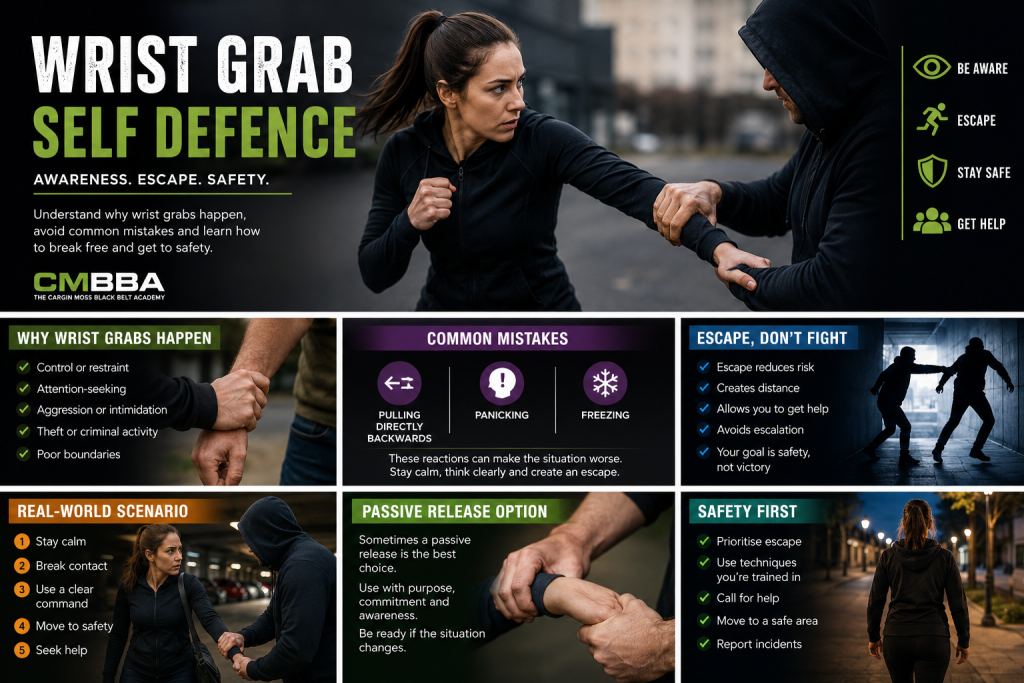
    wrist grab release in the safest way The goal of self defence is not to win a fight. The goal is to create an opportunity to get free, create distance and get to safety

    Key Takeaway

    Wrist grabs can happen for many different reasons, including attention-seeking, control, intimidation, criminal activity or poor judgement.

    Whatever the reason, your first priority should be your safety.

    Rather than automatically pulling harder, panicking or freezing, learn to recognise the situation, stay as calm as possible and look for an opportunity to break contact.

    The goal of self defence is not to win a fight. The goal is to create an opportunity to get free, create distance and get to safety.

    That is the mindset behind CMBBA training.

    Learn the technique. Practise the technique. Build confidence in your ability to respond.

    Because when something unexpected happens, preparation can make the difference between simply reacting and knowing what to do.
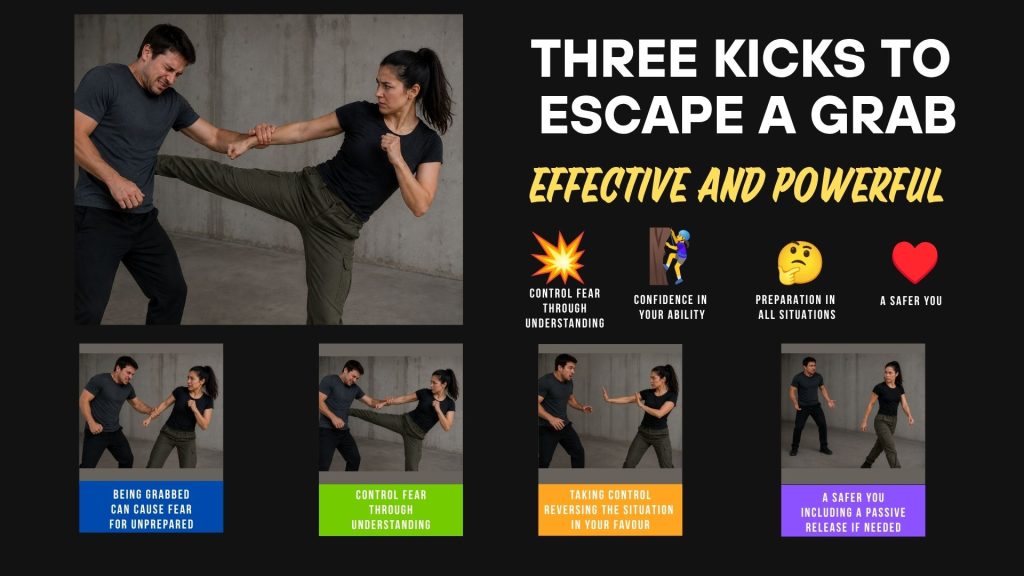
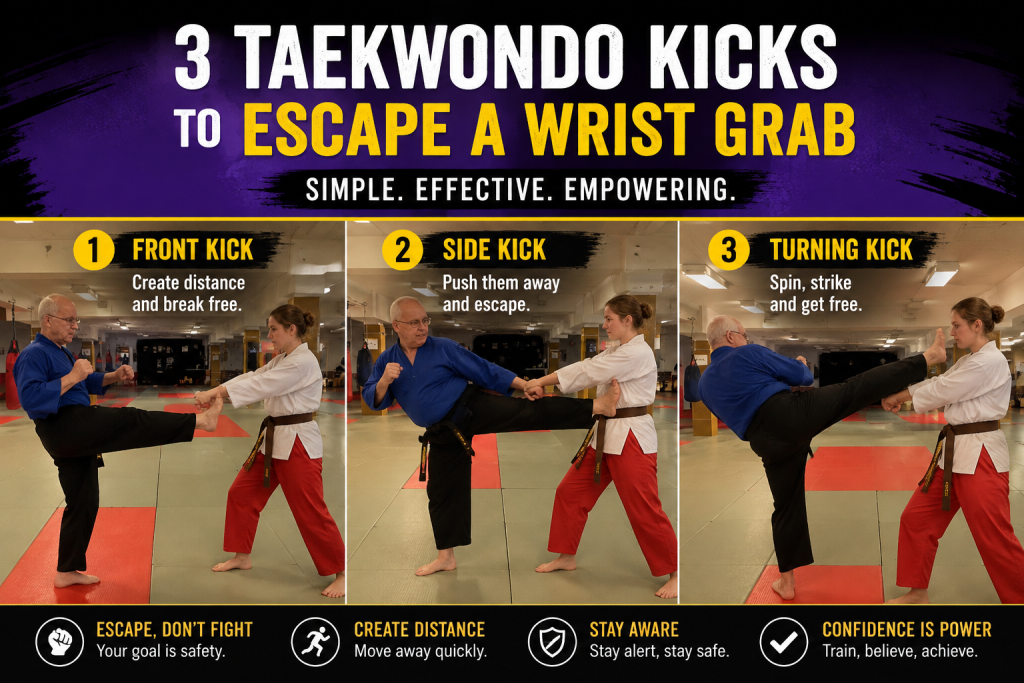
    Three kicks to escape a grab, front kick for quick release from a  grabber, side kick being another powerful kick and the turning turning kick. Three different kicks for every possibility.
additionally a quick passive release for first line of defence
    Three Taekwondo kicks to escape a wrist grab and the opportunity to get involved with the mini course to learn them in the safety of your own home, this is an excerpt from the CMBBA online home course

    Want to Learn How to Escape a Wrist Grab??

    The CMBBA Three Kicks to Escape a Wrist Grab mini-course takes you through practical techniques designed to help you understand what to do if someone grabs your wrist.

    You will learn the Front Kick, Side Kick and Turning Kick, along with a passive wrist release for situations where a less aggressive response may be appropriate.

    Don’t just watch a technique. Learn it, practise it and build confidence in your ability to respond.

    Click this link to get immediately access 👉
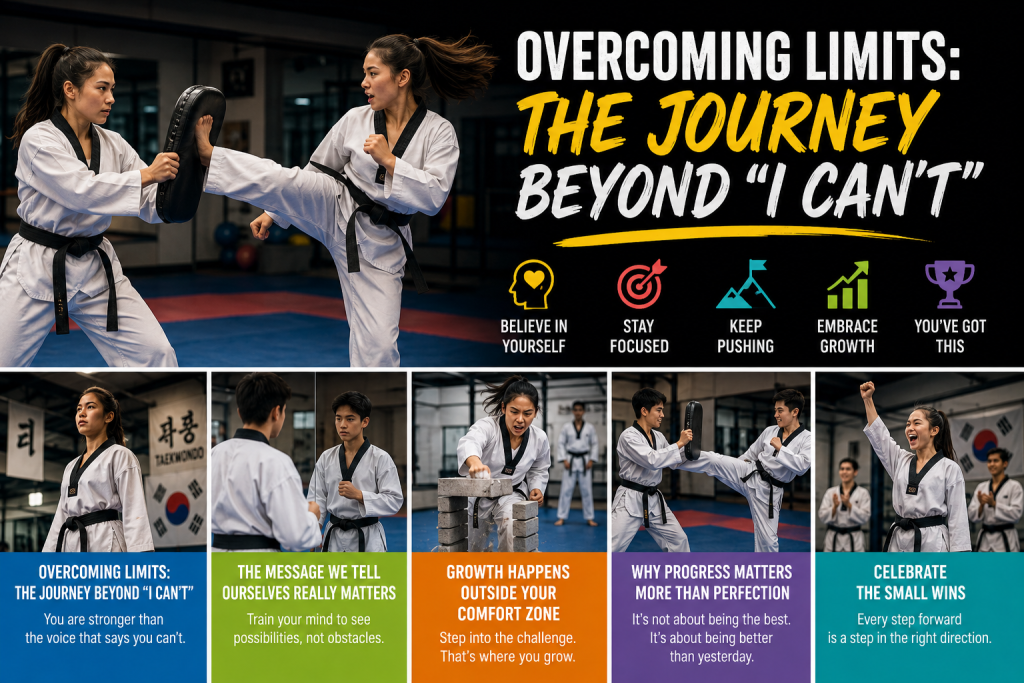
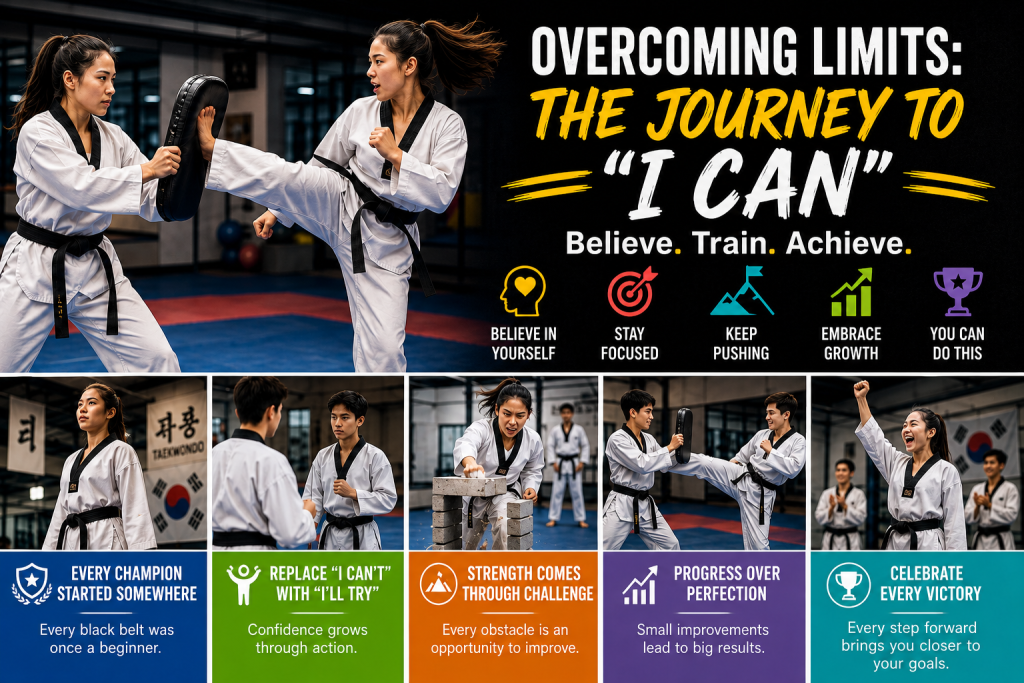
  • work on. —-Overcoming Self-Doubt: The Journey Beyond “I Can’t”

    Overcome the limits on a journey beyond the thought of I can't and the answer starts with, why not.

    “I can’t do this.”

    Most of us have said those words more times than we’d like to admit.

    Perhaps you’ve said them recently.

    They appear when life feels overwhelming, when a challenge seems impossible, or when failure feels almost certain. Whether you’re working towards a fitness goal, changing careers, starting a business, or simply trying to become a better version of yourself, self-doubt has a way of convincing you to stop before you’ve really begun.

    But here’s something worth remembering:

    The greatest limits we face are often the ones we place on ourselves.


    The Story You Tell Yourself Shapes Your Future

    Every journey begins with the conversations we have in our own minds.

    Some people tell themselves:

    • “I’m not smart enough.”
    • “I’m too old.”
    • “I’m too inexperienced.”
    • “People like me never succeed.”

    Over time, these thoughts become beliefs, and beliefs influence our actions.

    If you constantly tell yourself that you can’t succeed, your brain will look for evidence to prove you right. Fear, doubt and uncertainty quickly become excuses for standing still.

    But everything changes when you begin asking yourself a different question:

    “What if I can?”

    That single question shifts your attention away from obstacles and towards opportunities.

    And that’s where real growth begins.


    Growth Begins Outside Your Comfort Zone

    Comfort feels safe.

    Growth rarely does.

    Every worthwhile achievement starts with uncertainty.

    The first workout feels exhausting.

    The first presentation is nerve-racking.

    The first business idea seems risky.

    The first attempt is almost never perfect.

    That’s completely normal.

    The important thing is to keep going. With practice, difficult tasks become easier, your confidence grows, and success becomes more achievable.

    Many successful athletes, entrepreneurs and performers still experience nerves before important moments. The difference is that they have learned how to manage those feelings rather than allow them to control their actions.

    Once they begin, their focus replaces their fear.

    Courage isn’t the absence of fear—it’s refusing to let fear make your decisions.


    Progress Beats Perfection Every Time

    One of the biggest barriers to personal growth is believing everything must be perfect before you begin.

    You wait for:

    • The perfect time.
    • The perfect plan.
    • The perfect opportunity.
    • The perfect amount of confidence.

    The reality is that perfection doesn’t exist.

    Progress creates results.

    Improving by just one percent each day may seem insignificant, but those small improvements compound over time into remarkable achievements.

    Success isn’t built through giant leaps.

    It’s built through hundreds of small, consistent actions repeated day after day.


    Failure Is Part of Success

    Too many people see failure as a reason to quit.

    In reality, failure is one of life’s greatest teachers—if you’re willing to learn from it.

    Every setback builds resilience.

    Every mistake provides valuable feedback.

    Every obstacle develops strength, patience and wisdom.

    Think about the people who inspire you.

    Behind almost every success story are countless disappointments, setbacks and moments of self-doubt that nobody ever sees.

    Failure doesn’t define your future.

    Giving up does.


    Celebrate Every Small Win

    It’s easy to overlook how far you’ve come because you’re focused on how far you still have to go.

    Instead, celebrate your progress.

    Celebrate getting out of bed on a difficult day.

    Celebrate finishing a workout.

    Celebrate learning a new skill.

    Celebrate trying again after falling short.

    These aren’t small victories.

    They’re the building blocks of lasting confidence.

    Real self-confidence grows every time you keep a promise to yourself.


    Stop Comparing Your Journey

    Social media makes it easy to compare your beginning with someone else’s highlight reel.

    But everyone is on a different journey.

    Someone else’s success doesn’t reduce your own potential.

    The only comparison that truly matters is who you were yesterday.

    Personal growth isn’t about moving faster than everyone else.

    It’s about refusing to stop moving forward.


    start the journey from 'I can't' to 'I can' is a mindset and belief which is powerful when you get it correct. the journey start from within.

    Change Your Inner Dialogue

    The words you repeat to yourself become the beliefs you live by.

    Pay attention to how often you say:

    • “I can’t.”
    • “I’m not ready.”
    • “I’ll never be good enough.”

    Now replace them with:

    • “I’m learning.”
    • “I’m improving.”
    • “I can take the next step.”
    • “This is difficult, but I can grow through it.”

    Small changes in your thinking lead to powerful changes in your behaviour.

    And your behaviour determines your future.


    Your Journey Starts Today

    You don’t need extraordinary talent to achieve extraordinary things.

    You don’t need perfect timing.

    You don’t need every answer before you begin.

    You simply need the courage to take the first step.

    Every athlete was once a beginner.

    Every entrepreneur started with an idea.

    Every expert struggled with the basics.

    The difference wasn’t natural ability.

    It was persistence.


    Final Thoughts

    Learning how to overcome self-doubt isn’t about becoming fearless.

    It’s about choosing progress over perfection, one step at a time.

    There will be setbacks.

    There will be difficult days.

    There will be moments when quitting feels easier than carrying on.

    Keep moving forward anyway.

    Every challenge develops resilience.

    Every effort strengthens your confidence.

    Every small victory brings you closer to the person you’re capable of becoming.

    Don’t allow self-doubt to write your story.

    Write a new one—one where courage overcomes fear, persistence defeats obstacles, and progress matters more than perfection.

    Because your greatest achievement may be waiting just beyond the words:

    “I can’t.”

  • Why Self-Discipline Is the Real Key to Success

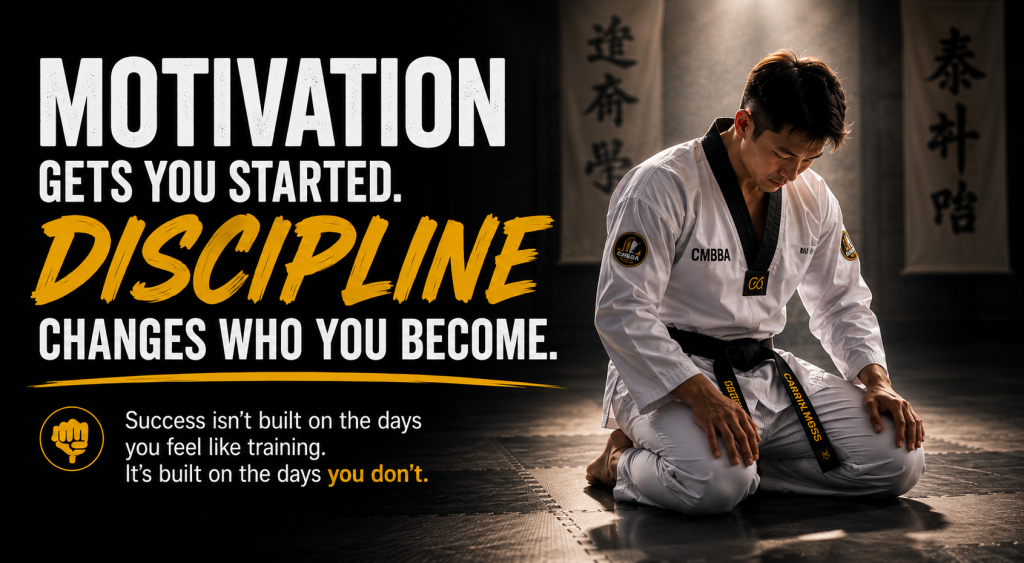
    Motivation is a great start but it takes discipline to continue the journey to success, use the two together

    What Is the Difference Between Motivation and Discipline?

    Discipline over motivation is one of the most important lessons anyone can learn. Motivation may inspire you to start exercising, learn martial arts, or improve your life, but it rarely lasts. Discipline, on the other hand, keeps you moving forward long after the excitement disappears. Whether your goal is fitness, personal development, or mastering martial arts, self-discipline is what turns good intentions into lasting success.

    Anyone who has ever set a New Year’s resolution knows the bitter truth: motivation is fleeting. It is a mood, not a muscle; it is dependent on how we feel, the weather, or the results we see in the short term. When the novelty fades, when fatigue sets in, or when progress stalls, motivation vanishes—and without something stronger to hold us steady, we quit.

    Why Discipline Is Better Than Motivation

    Discipline is not the absence of desire, nor is it a rigid form of self-punishment. It is the quiet commitment to act in alignment with your values and goals, regardless of how you feel. It is the understanding that greatness is not born from occasional bursts of energy, but from the accumulation of small, deliberate, and repeated actions. This article explores why discipline is the true foundation of character, how consistent practice forges willpower, responsibility, and resilience, and how these traits become the bedrock of success in every domain of life. The story of the hare and tortoise come in mind here.

    How Discipline Builds Self-Control and Willpower

    Modern culture often glorifies the idea of “following your passion” or “staying inspired.” We are told that if we just love what we do, success will follow naturally. This is a dangerous misconception. Passion gets you started, but discipline keeps you going. Motivation is like the wind; it can carry you forward, but it is unpredictable and dies down often. Discipline is the engine—it keeps moving even when the air is still.

    Psychologically

    This distinction is rooted in how our brains work. Motivation relies on the dopamine reward system, which craves immediate gratification. When you start something new, dopamine levels spike, creating excitement. But as the task becomes routine, or as challenges arise, dopamine drops, and the drive fades. Discipline, however, engages the prefrontal cortex—the part of the brain responsible for planning, impulse control, and long-term decision-making. When you choose discipline, you are training your brain to prioritise long-term rewards over immediate comfort.

    How Martial Arts Teach Discipline for Life

    A figure who embodies this principle perfectly. No one feels like training every single day. There are days when the body is sore, the mind is distracted, and the spirit feels heavy. But the practitioner shows up anyway. They do not train because they are always motivated; they train because they are disciplined. And in that repetition, something profound happens: they stop relying on how they feel and start building who they are.

    Tomorrow's result rely on today's effort which start from attendance in mind, body and sprit and be in the moment

    How Discipline Builds Self-Control and Will power

    Willpower is often described as the ability to resist short-term temptations to meet long-term goals. For a long time, researchers believed willpower was a limited resource—like a battery that drains throughout the day. However, newer studies suggest that willpower is more like a muscle: it can be strengthened through regular exercise, and it becomes stronger the more you use it.

    Every time you choose to do what you should do instead of what you want to do, you are lifting a weight for your character. If you commit to practicing for 30 minutes every day, even when you are tired, you are exercising that muscle. Over time, what once felt impossible becomes second nature.

    The Benefits of Discipline in Everyday Life

    The discipline you build in one area of your life transfers to others. Someone who disciplines themselves to wake up early and train will likely find it easier to stay focused at work, manage their finances wisely, or maintain healthy relationships. Why? Because the neural pathways associated with self-control have been reinforced.

    In martial arts, this is visible in the progression from white belt to black belt. The techniques themselves are only part of the learning. The real lesson is learning to control your body and your impulses. You learn to remain calm under pressure, to focus when you are exhausted, and to persist when you fail. That self-mastery—built through thousands of repetitions—is the essence of willpower. It becomes a resource you can draw upon when life demands difficult choices, allowing you to act with integrity and purpose rather than reacting impulsively.

    How to Build Self-Discipline Every Day

    Discipline and responsibility are inseparable. When you rely on motivation, you are essentially saying, “I will do this if I feel like it.” This places the control outside of yourself—your actions depend on external factors or your emotional state. When you embrace discipline, you take full ownership. You declare, “I am responsible for my progress, my growth, and my results.”

    Responsibility is the understanding that you are the architect of your own life. Consistent practice teaches you that there are no shortcuts and no excuses. If you miss a session, you do not blame the weather, your schedule, or a lack of energy. You acknowledge that you made a choice, and you adjust accordingly. This mindset shifts you from being a victim of circumstances to being the creator of your reality.

    Why Discipline Builds Mental Resilience

    You set goals, you create a plan, and you execute it daily. You begin to see a direct link between your effort and your outcome. This awareness fosters accountability. You realise that every action—no matter how small—matters. A missed practice here, a lazy effort there—these things add up. Conversely, consistent effort, even in small increments, compounds into mastery.

    This sense of responsibility transforms how you interact with the world. In your career, it means meeting deadlines without needing supervision. In your relationships, it means showing up reliably and keeping your word. In your personal health, it means making choices that honour your body. Discipline teaches you that freedom is not doing whatever you want; freedom is the ability to do what you know is right, regardless of the cost. That is true responsibility.

    Forging Resilience: The Ability to Bend Without Breaking

    Life is unpredictable. We all face setbacks, failures, injuries, and disappointments. Motivation crumbles in the face of hardship. When things go wrong, it is easy to say, “It’s too hard, I’m not good enough, I give up.” But discipline builds resilience—the capacity to recover quickly from difficulties and keep moving forward.

    Resilience is not about being tough or never feeling pain. It is about what you do after you fall. Discipline gives you a structure to rely on when your world feels chaotic. When everything else falls apart, your routine remains. In the words of the famous philosopher and martial artist Bruce Lee: “Do not pray for an easy life, pray for the strength to endure a difficult one.” That strength comes from consistency.

    Every time you push through a barrier in training

    You are training your mind to handle adversity. You learn that discomfort is not a signal to stop, but a sign that you are growing. You learn that failure is not the opposite of success; it is part of it. Each time you correct a mistake and try again, you build mental toughness.

    This resilience becomes a shield in everyday life. When you face a crisis at work, a personal loss, or a period of uncertainty, the habits you have built through discipline kick in. You don’t panic; you take things one step at a time. You focus on what you can control—your attitude, your effort, and your actions. You know from experience that you have survived hard days before, and you have the strength to survive them again. That is the unbreakable character that discipline creates.

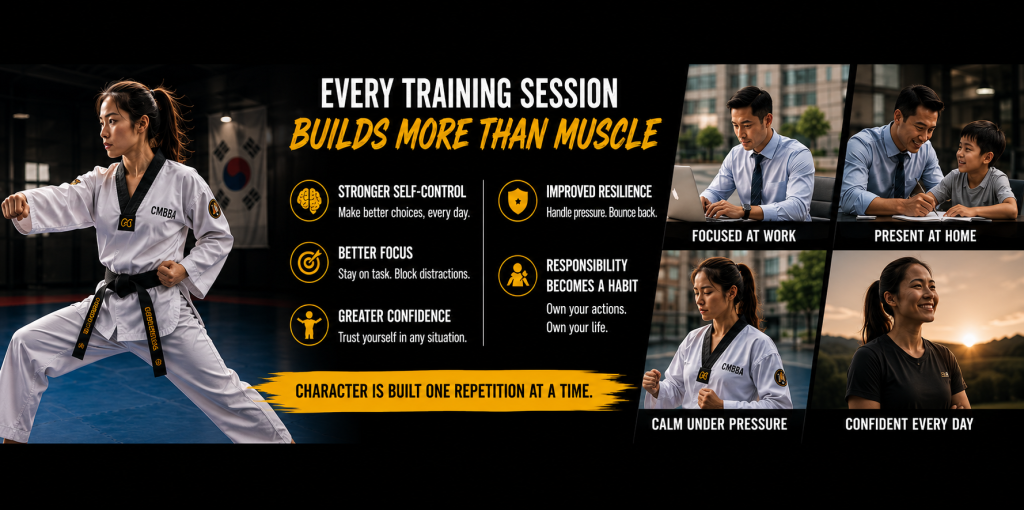
    Every training session in a step further into the results you want now and in the future. What you are building now will effect your future

    How Discipline Translates to Every Area of Life

    The benefits of building character through discipline are universal. The skills you develop through consistent practice are transferable assets that serve you in every role you play.

    In Your Career:

    Professional success rarely comes from talent alone. It comes from reliability, focus, and the ability to deliver results over a long period. A disciplined professional is someone who shows up early, prepares thoroughly, and persists through complex problems. They are trusted because they are consistent. They do not wait for inspiration to strike to get work done; they create value regardless of the situation. This builds a reputation for excellence and opens doors to opportunities that others miss.

    In Relationships:

    Love and friendship require maintenance. It is easy to be kind and patient when everything is going well. But it takes discipline to listen when you are tired, to forgive when you are hurt, and to communicate clearly when you are angry. Discipline helps you manage your emotions so that you treat others with respect and loyalty. It builds trust, the foundation of all strong connections.

    In Health and Wellbeing:

    Physical health is a direct result of daily choices. Eating well, sleeping enough, and moving your body are acts of discipline. When you treat your body with respect through consistent habits, you feel better physically and mentally. This creates a positive cycle: discipline improves your health, and good health gives you the energy to maintain your discipline.

    In Personal Growth:

    Whether you want to learn a language, write a book, or master a trade, progress is linear only if you are consistent. Discipline turns a distant dream into a daily reality. It allows you to compound your knowledge and skills, turning potential into actuality.

    Practical Steps to Build Discipline

    Building discipline is a journey, not a destination. Here is how you can start today:

    1. Start Small:

    Do not try to overhaul your life overnight. Choose one area—perhaps your morning routine or your physical training—and commit to a very small action. If you want to exercise, commit to just 10 minutes a day. Success builds confidence, and confidence builds discipline.

    2. Create a Routine:

    Discipline thrives on structure. When actions become habits, they require less mental energy. Design your day so that your most important tasks happen at the same time every day.

    3. Focus on the Process, Not the Result:

    You cannot always control the outcome, but you can always control your effort. Shift your focus from “Did I win?” to “Did I give my best effort today?”

    4. Embrace Discomfort:

    Growth happens outside your comfort zone. When you feel resistance, that is exactly where you need to go. Learn to say: “This is hard, and that means I am growing.”

    5. Hold Yourself Accountable:

    Write down your goals and track your progress. Be honest with yourself. If you slip up, forgive yourself and get back on track immediately. Consistency is more important than perfection.

    Discipline Over Motivation: Final Thoughts

    Motivation is the spark, but discipline is the fire. It is the steady, unwavering heat that forges steel from iron. By choosing consistency over intensity, and commitment over inspiration, you build a character that is unbreakable.

    Through the simple act of showing up—day after day, whether you feel like it or not—you develop willpower that resists temptation, responsibility that grounds your choices, and resilience that carries you through the storms of life. These traits do not just make you better at your practice; they make you better at being human.

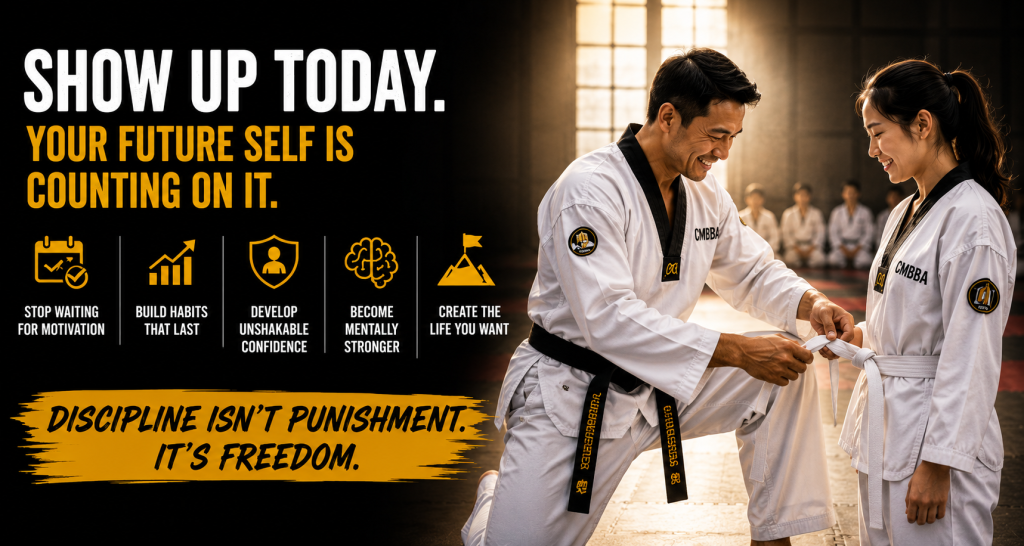
    Ultimately, discipline is not about restricting yourself. It is about freeing yourself. It is the key that unlocks your true potential, allowing you to live a life of purpose, integrity, and strength. So, do not wait until you feel motivated. Start now. Show up. And remember: the character you build today is the life you will live tomorrow.

    an the prospect of learning martial arts be daunting or even scary?

    Well if the martial arts movies of the late eighties and their recent reboots on streaming television services are to be believed, then understandably some people might be put off embarking on learning martial arts because they think it will be to competitive.

    Well, we think that is a shame.

    So what we’ve done to try and remove ALL obstacles to adults or children coming down and taking that first brave step, is to offer a first FREE session

    https://www.cmbba.com/classes/index.php