What Are the Biggest Self-Defence Myths?
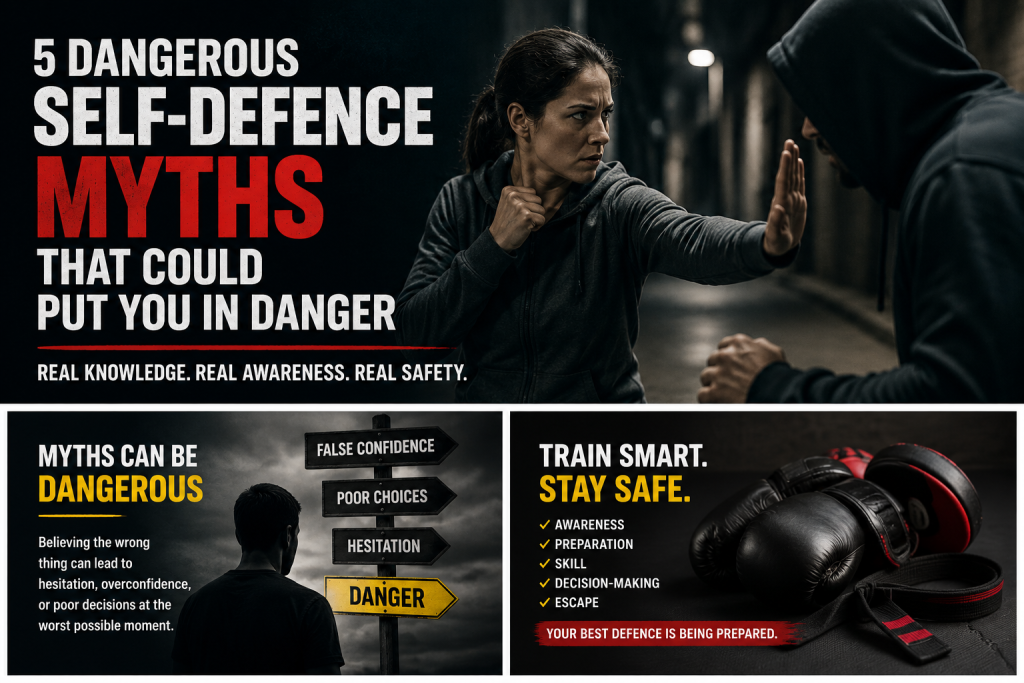
The truth is, when it comes to personal safety, misinformation can be just as dangerous as a lack of training. Many people base their understanding of self-defence on films, social media, or stories they’ve heard from others. These common self-defence myths can create false confidence, poor decision-making, and hesitation when it matters most.
Most people think they understand what self-defence looks like. Popular culture tells us that bigger people always win, martial arts experts can handle any threat, and confidence alone is enough to survive violence.
Real-world confrontations are rarely clean, controlled, or predictable.
Violence is fast, emotional, chaotic, and deeply uncomfortable. In many situations, what keeps someone safe is not strength or flashy technique — it’s awareness, preparation, decision-making, and the ability to act under pressure.
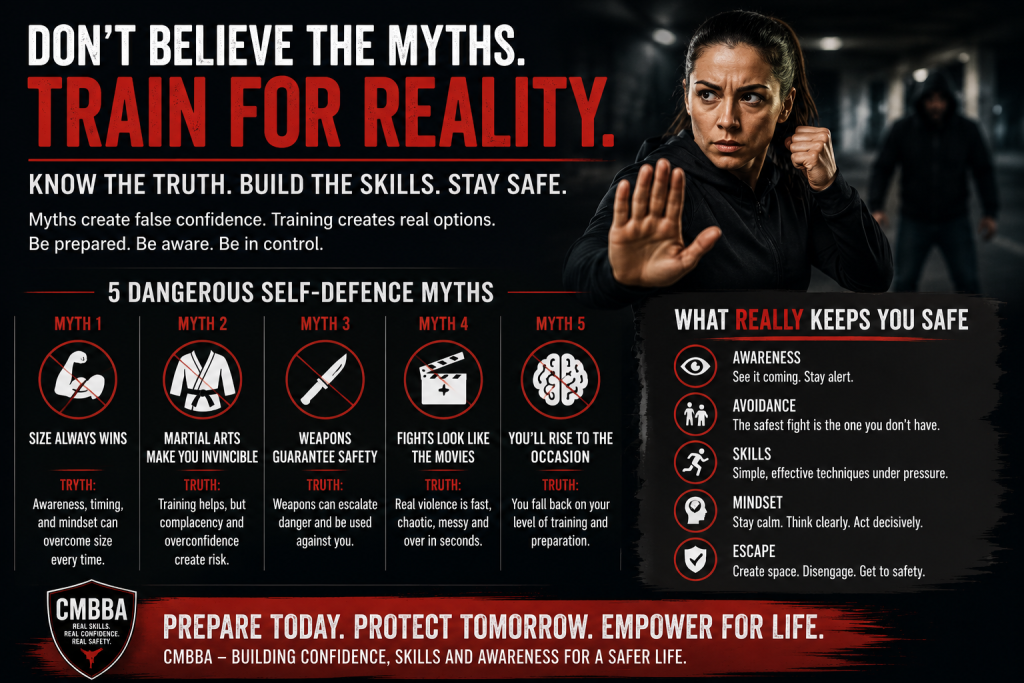
Here are five dangerous self-defence myths — and the reality behind them.
Myth #1: “Size Always Wins”
Physical size and strength absolutely matter in a confrontation. Ignoring that reality would be irresponsible. A more aggressive or stronger person can deliver more force, recieve more impact, and often intimidate you before a fight even begins.
Size alone does not determine the outcome of every encounter.
Real self-defence is not a sporting contest where two people square off under equal conditions. Many assaults are opportunistic.
An attacker will rely on surprise, intimidation, fear, or overwhelming aggression rather than skill alone.
When you recognise danger early, you can creates distance, stays mobile, and react decisively, you may have a far better chance of escaping than someone who is physically larger who freezes or hesitates.
This is why effective self-defence training focuses heavily on practical skills beyond physical power.
Why Awareness Beats Strength
Situational awareness
Understand that awareness is one of the most important self-defence tools anyone can develop.
Dangerous situations provide warning signs before violence actually occurs:
- Someone invading personal space
- Aggressive body language
- Unusual attention or targeting
- Escalating verbal behaviour
- Environmental red flags
People who stay alert to their surroundings tend to avoid danger before it becomes physical.
Being aware also means understanding your environment:
- Identifying exits
- Avoiding isolated areas
- Not becoming distracted by phones or headphones
- Recognise when a situation feels “off”
The earlier you detect a risk, the more options you have to cope with them.
Boundary setting
A lot of confrontations escalate because people ignore the early discomfort or they feel pressured to remain polite.
Strong verbal boundaries can prevent situations from progressing:
- “Back up.”
- “I don’t want any trouble.”
- “Stop.”
- “Stay away from me.”
Showing clear communication, confident posture, and assertive behaviour you can discourage opportunistic aggression before physical action is necessary.
Why Distance Matters
Distance management is one of the greatest advantages in self-defence.
The closer someone gets, the fewer reaction options you have. Managing distance gives you:
- More time to respond
- Better visibility
- More escape opportunities
- Reduced vulnerability to sudden attacks
A physically smaller person who maintains distance effectively may avoid being grabbed or overwhelmed entirely.
De-escalation
Not every confrontation needs to become physical.
De-escalation involves reducing the emotional intensity rather than feeding it. This can include:
- Staying calm
- Avoiding insults or ego battles
- Using non-threatening body language
- Creating opportunities to disengage safely
The goal is not to “win” an argument. The goal is to leave safely.
Why Simplicity Wins Under Pressure
Simple, high-percentage techniques
Under stress, complicated movements often fail.
That’s why practical self-defence prioritises simple actions that are easier to perform under pressure:
- Escaping grabs
- Protecting vulnerable areas
- Creating space
- Using body movement efficiently
- Escaping quickly
The objective is survival and escape — not domination.
Stress response management
Adrenaline dramatically affects the body:
- Heart rate spikes
- Breathing changes
- Coordination drops
- Vision narrows
- Fine motor skills deteriorate
Training helps people function better despite the stress, instead of being overwhelmed by it.
Myth #2: “Martial Arts Will Make You Invincible”
Martial arts training can be incredibly valuable. It builds fitness, discipline, confidence, timing, coordination, and resilience.
No training system can guarantee safety in every situation.
Real violence is unpredictable. There are variables no training environment can fully replicate:
- Multiple attackers
- Weapons
- Confined spaces
- Surprise attacks
- Extreme fear
- Environmental hazards
Even highly trained individuals can be caught off guard.
Training builds capability — not invulnerability
Good training improves:
- Reaction speed
- Confidence under pressure
- Physical conditioning
- Decision-making
- Emotional control
Having the knowledge does not remove risk.
In addition, believing you are unbeatable is risky because overconfidence can lead to unnecessary confrontation.
Avoidance is still a skill that needs to be well rehearsed.
One of the most important lessons in legitimate self-defence is that training is learning when not to engage.
Walking away:
- Protects your safety
- Reduces legal risk
- Prevents escalation
- Keeps emotions under control
The strongest people are often the least eager to fight.
Real confidence includes humility
Experienced practitioners usually become more cautious over time, not less.
They understand:
- Violence is unpredictable
- Anyone can be injured
- One mistake can change a life permanently
- Ego is dangerous
True confidence is calm, measured, and realistic.
Myth #3: “Weapons Guarantee Safety”
Many people assume carrying a weapon automatically gives them control in a dangerous situation.
Without proper training and emotional control, a weapon can:
- Escalate fear and aggression
- Increase panic
- Be taken away
- Create legal consequences
- Cause irreversible harm
A weapon does not replace judgment.
Stress changes performance
Under extreme stress:
- Hands shake
- Fine motor control deteriorates
- Tunnel vision develops
- Decision-making slows
People often overestimate how effectively they will perform in a crisis.
Escalation happens fast
The introduction of a weapon can instantly raise the stakes of an encounter.
What may have been a verbal confrontation can suddenly become life-threatening.
Therefore, mindset matters more than tools.
Self-defence begins long before physical force.
People who stay aware, trust instincts, maintain boundaries, and leave risky situations early often avoid violence entirely.
Before we look at the next myth
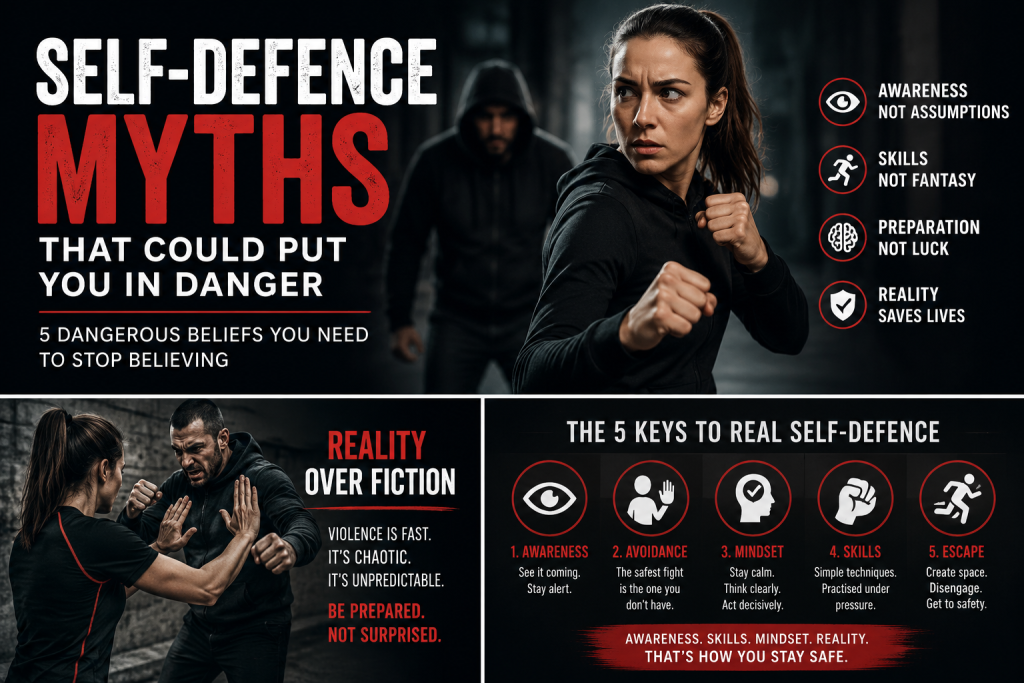
As a fact, every dangerous misconception has one thing in common—it encourages people to rely on assumptions rather than preparation.
Myth #4: “Fights Look Like the Movies”
Films and television create deeply unrealistic expectations about violence.
Movie fights are designed to entertain:
- Choreographed exchanges
- Perfect timing
- Long dramatic battles
- Clean techniques
- Predictable reactions
Real violence is usually sudden and chaotic.
Real fights are messy
In genuine confrontations:
- People stumble
- Movements become sloppy
- Fear affects coordination
- Communication breaks down
- Situations escalate unpredictably
Most altercations are over very quickly.
Adrenaline changes everything
During the state of high stress:
- Hearing may distort
- Time perception may change
- Memory becomes unreliable
- Breathing becomes shallow
People often struggle to perform even simple tasks effectively.
Surprise is common
Assaults do not begin with obvious warning.
They may involve:
- Distraction
- Deception
- Ambush
- Sudden aggression
- Emotional manipulation
That’s why realistic training includes pressure and unpredictability — not just memorising techniques in controlled settings.
Myth #5: “You’ll Rise to the Occasion Automatically”
People assume they will instinctively know what to do in a dangerous situation.
The body’s survival response is complex.
Fight.
Flee.
Freeze completely.
All are natural human reactions.
Freezing is normal
When someone is confronted with sudden danger, the brain may struggle to process information quickly enough.
People can become:
- Mentally overwhelmed
- Physically rigid
- Hesitant
- Confused
This is not weakness — it is a biological survival response.
Training creates familiarity
Realistic training helps reduce panic by exposing people to controlled stress.
Repetition develops:
- Faster reactions
- Better decision-making
- Greater emotional control
- Increased confidence
The goal is not fearlessness. The goal is functionality under pressure.
Confidence is built beforehand
People rarely perform at a level they have never practised.
Therefore preparation matters because it creates:
- Familiarity
- Automatic responses
- Emotional resilience
- Better judgment
In a crisis, people often default to their habits and training — not idealised expectations.
The Reality of Self-Defence
Real self-defence isn’t about winning fights. It’s about getting home safely.
It is about improving your ability to:
- Recognise danger early
- Make smart decisions
- Stay emotionally controlled
- Create opportunities to escape
- Protect yourself and others
- Survive unpredictable situations
The most effective self-defence mindset is grounded in realism, not fantasy.
When people understand what violence actually looks like — and prepare accordingly — they make safer, smarter decisions when it matters most.
Frequently Asked Questions About Self-Defence
What is the biggest self-defence myth?
The biggest myth is that physical strength alone determines who wins, awareness, decision-making, preparation and the ability to escape are often far more important than size or strength.
Can martial arts guarantee your safety?
No Martial arts develop confidence, fitness and practical skills, but no training can remove all risk.
Good self-defence also involves awareness, avoidance and sound judgement.
Is carrying a weapon the best form of self-defence?
Not necessarily. Without appropriate training and a clear understanding of the law, weapons can increase risk and escalate situations. Awareness and avoidance remain your first line of defence.
What is the most important self-defence skill?
Situational awareness. Recognising danger early gives you more time, more options and a greater chance of avoiding violence altogether.