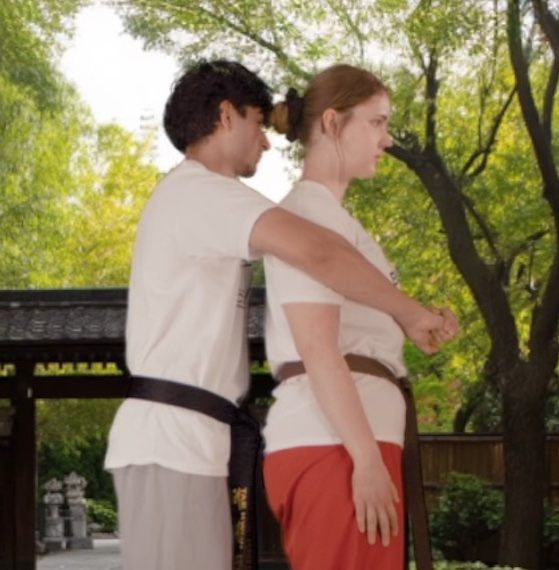
Escapes from a Bear Hug can be a frightening experience because it can happen suddenly and restrict your movement before you have time to think. Learning a bear hug self defence can help you understand what to do when someone grabs you from the front or behind.
In the real-world self-defence the situations are rarely like movie fight scenes. They can happen quickly, feel chaotic and trigger a natural stress response such as panic or freezing. That is why learning simple, practical bear hug escape techniques can help you develop greater awareness, confidence and the ability to respond under pressure.
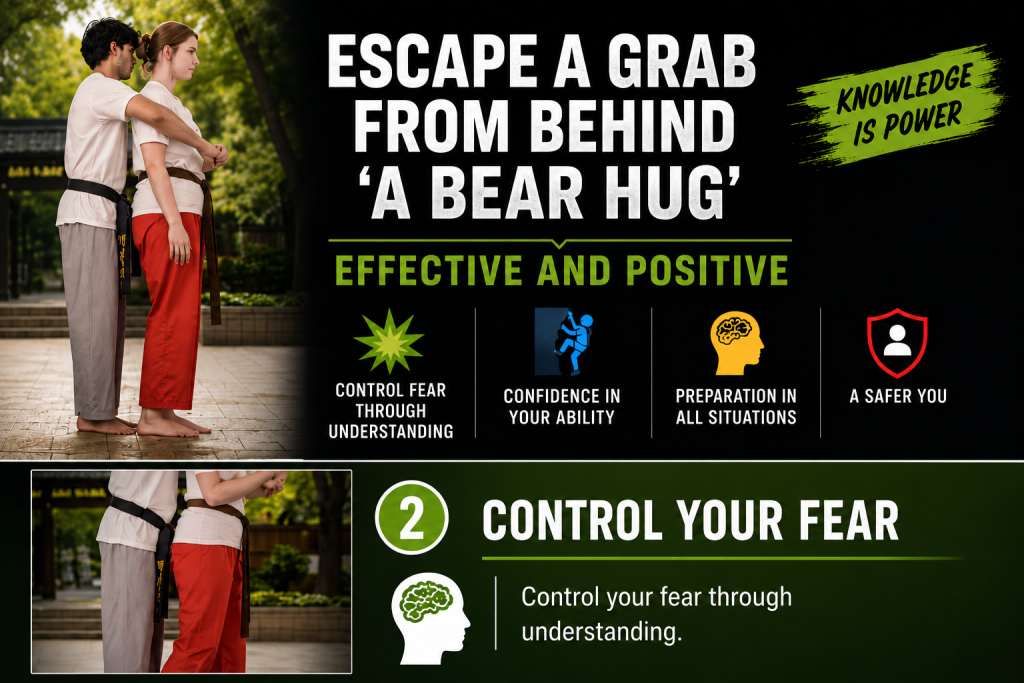
The most important principle is simple:
The goal is not to win a fight. The goal is to create an opportunity to escape and get to safety.
A bear hug can restrict your arms, affect your balance and make movement difficult. Your response therefore needs to be focused, controlled and appropriate to the situation.
In this guide, we look at four practical bear hug escape principles, along with the mindset and training principles that can help you respond more effectively.
First: Don’t Panic
When someone suddenly grabs you, your natural reaction may be to panic, hold your breath, tense your muscles or immediately try to overpower them.
That reaction is understandable.
However, panic can make it harder to think clearly and move effectively.
Instead, focus on four priorities:
- Control your breathing.
- Protect your balance.
- Create space.
- Escape as soon as an opportunity appears.
Even if the other person is stronger, your objective is not to win a strength contest.
Your objective is to disrupt their control long enough to create an opportunity to get free.
A calm and purposeful response is generally more useful than frantic resistance.
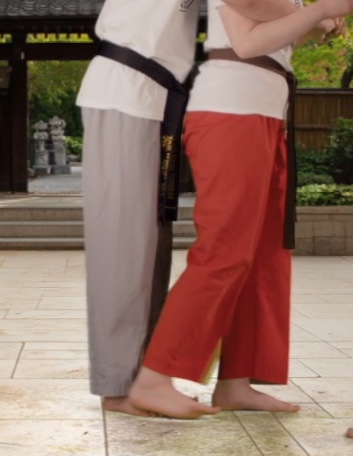
Bear Hug Escape #1: Foot Stomp and Turn
A foot stomp and turn can provide an option when your arms are trapped and you need to create an opportunity to move.
Why It Can Work
A sudden movement involving the foot may create a distraction or change in the person’s grip. That moment can provide an opportunity to turn and move away.
The important point is that the stomp is not the escape.
The movement that follows is what creates the opportunity to get free.
Step-by-Step
1. Stay Grounded
Keep your stance stable.
Losing your balance can make it harder to move effectively, so avoid allowing yourself to be pulled completely off your feet.
2. Create Disruption
If appropriate to the circumstances, use a committed foot stomp to create a moment of distraction.
The objective is not to remain and fight.
The objective is to create an opportunity to move.
3. Turn Your Body
As soon as an opportunity appears, rotate your body toward the opening.
Changing your angle can make it more difficult for the other person to maintain the same level of control.
4. Bring Your Arms Through
As space develops, work your arms upward and outward to help create separation.
5. Move Away
Once you are free, do not remain in the confrontation.
Create distance and move toward safety, other people or a well-lit location where possible.
The CMBBA Principle
Disrupt → Turn → Escape.
Many people focus on the initial strike or movement and forget the most important part: getting away.
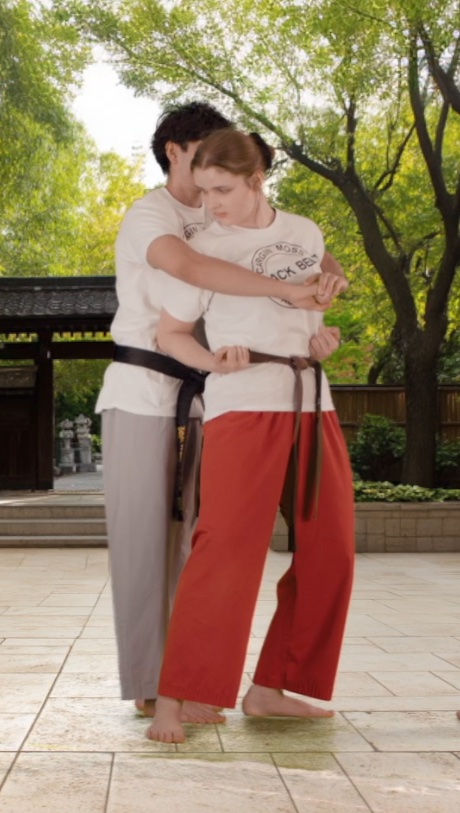
Bear Hug Escape #2: Elbow Strike and Separation
An elbow-based escape can be an option in a close-contact situation where someone is holding you from behind.
The important principle is that any physical action should be used to create an opportunity to escape, rather than becoming a prolonged fight.
Why Elbows Can Be Useful at Close Range
In very close situations, there may not be enough space to use a conventional punch effectively.
An elbow can be used within a much smaller range of movement.
However, the objective remains the same:
Create disruption, create space and escape.
Step-by-Step
1. Protect Your Balance
Keep your knees slightly bent and establish a stable base.
As you turn, widen your stance if necessary to give yourself greater stability and create space to work.
2. Create a Sharp Movement
If physical action is necessary and appropriate, use a controlled elbow movement to create disruption.
Depending on the circumstances, the movement may be directed toward areas such as the body.
3. Create Separation
The purpose of the movement is to create an opportunity for separation.
Avoid becoming focused on repeated strikes when your priority is escape.
4. Turn and Escape
As soon as the grip loosens or an opening appears, pivot toward the available space and move away.
Use your legs to create distance rather than remaining close to the person.
Remember
The elbow is not the objective.
The objective is freedom of movement and escape.
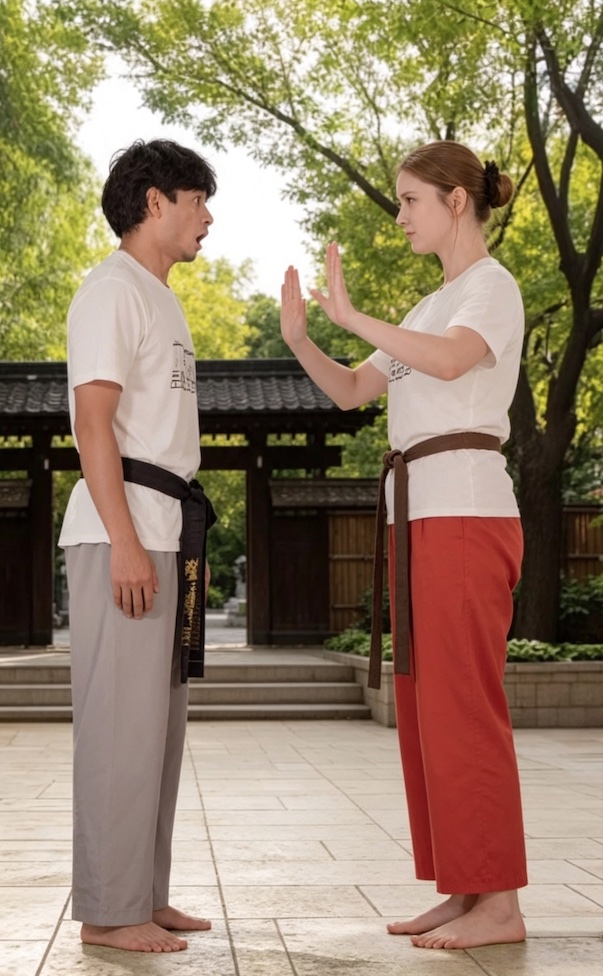
Bear Hug Escape #3: Creating an Opening to Release and Go
There may be circumstances where a direct physical response is necessary to create an opportunity to escape.
The exact response will depend on the position of the person’s grip, the environment and the level of threat.
If your arms are restricted, the available movements may be limited. If the grip is lower around the waist, different opportunities may become available.
The key principle is to avoid becoming fixed on one technique.
Instead, learn to recognise:
Where is the opening?
How can I create space?
How can I get away?
Protect Your Balance
Maintain a stable base and avoid allowing the person to easily pull you off balance.
Turning your body can change the angle of the grip and may create additional space for movement.
Create Disruption
If a physical response is necessary, the purpose should be to create enough disruption to allow you to escape.
Do not confuse disruption with fighting.
You are creating an opportunity to release and go.
Turn and Escape
As soon as an opening appears, turn toward it and move away.
Create distance and move toward safety, people or a well-lit location where possible.
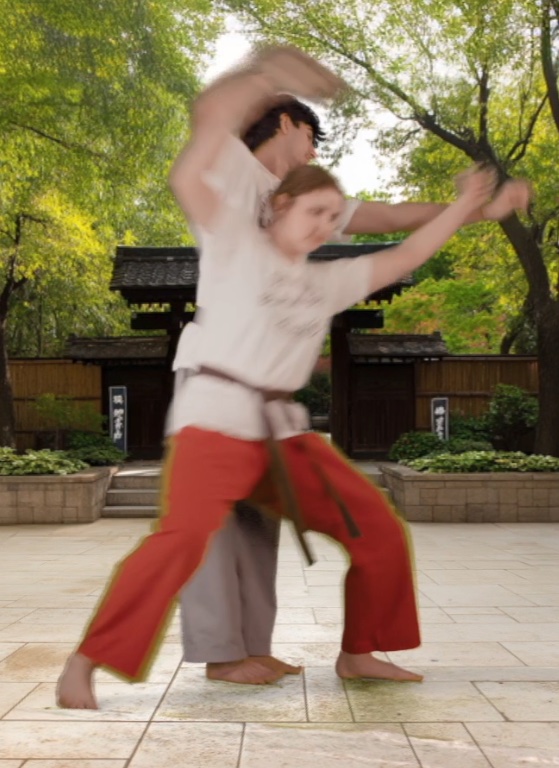
Bear Hug Escape #4: Base Drop, Hip Shift and Release
The base drop, hip shift and release is particularly useful as a principle when someone grabs you tightly around the upper body from behind.
Instead of trying to overpower the person’s arms, the focus is on your base, your hips and your ability to change the angle of control.
Why the Base Drop Can Help
A strong base makes it more difficult for someone to move your body easily.
Rather than trying to pull upward against the grip, think about becoming more stable and difficult to move.
Step-by-Step
1. Drop Your Weight
Bend your knees and lower your hips.
Think about becoming heavy and stable.
This can make it harder for someone to lift or drag you.
2. Widen Your Base
Step to the side where appropriate to create a more stable stance.
Your balance is critical.
3. Shift Your Hips
Turn your hips toward one side.
Changing the position of your hips can alter the angle of the person’s grip and help create an opening.
4. Use the Opening
As space develops, bring your arms upward and work toward creating separation.
5. Turn and Move Away
Once an opportunity appears, rotate toward the opening and move away.
Create distance immediately and head toward safety.
Common Mistake
One common reaction is to try to pull upward against the person’s grip.
This can waste energy and may allow the person to maintain control.
Instead, think:
Lower your base. Change your angle. Create an opening. Escape.
Why Simplicity Matters in Bear Hug Self Defence
Under pressure, complicated techniques can become difficult to remember and perform.
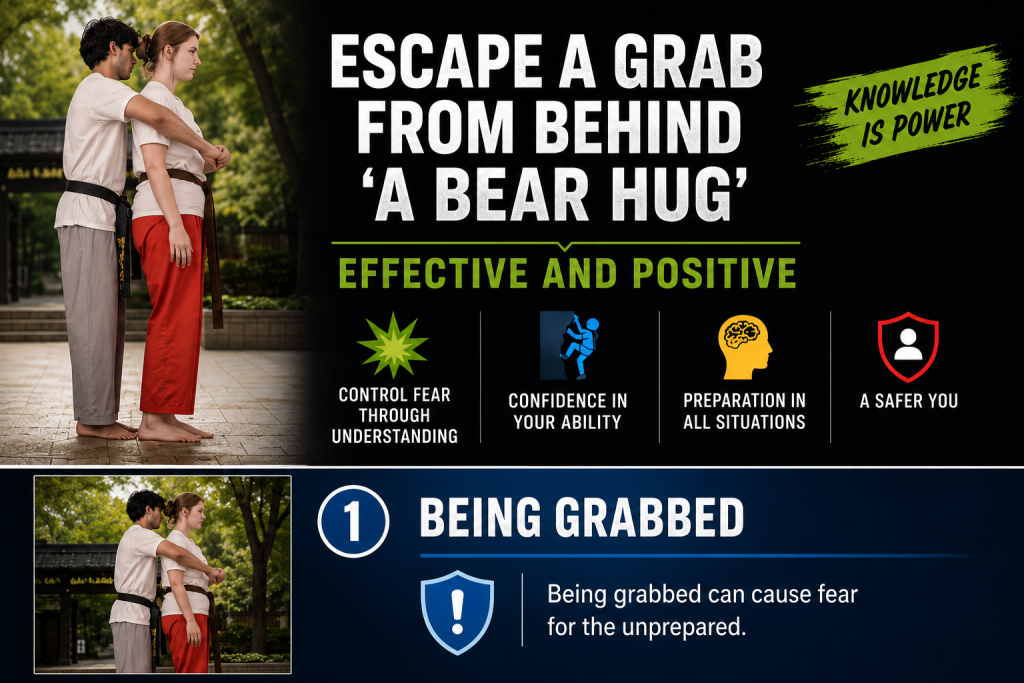
That is why CMBBA focuses on practical movements that can be learned, repeated and developed through training.
Effective self-defence movements should aim to be:
- Simple
- Practical
- Fast
- Easy to remember
- Repeatable under pressure
The purpose of training is not to memorise hundreds of techniques.
It is to develop confidence in a smaller number of useful principles and movements.
The more familiar the movement becomes through correct practice, the more naturally you may be able to respond when surprised.
Awareness Is Part of Self Defence
Physical techniques are only one part of personal safety.
Situational awareness can help you recognise potential problems before they become physical.
Good awareness includes:
- Staying alert in public places.
- Avoiding unnecessary isolated situations where possible.
- Trusting your instincts when something feels wrong.
- Maintaining appropriate personal space.
- Paying attention to unusual behaviour.
- Recognising changes in a situation before they escalate.
The earlier you recognise a potential problem, the more options you may have.
That is why at CMBBA we believe self defence begins before the grab happens.
What You Should NOT Do During a Bear Hug
Don’t Freeze
Freezing can be a natural response to a sudden threat.
However, controlling your breathing and focusing on your next action can help you regain control.
Remembering that talking or shouting requires you to breath and not hope your breath which is the early stages of freezing
Don’t over think the situation.
Breathe. Move. Create an opportunity. Go.
Don’t Try Fancy Techniques
Complex martial arts techniques may be difficult to perform under pressure unless they have been thoroughly practised.
Keep your movements simple and purposeful.
Don’t Turn It Into a Fight
Once you have created an opportunity to escape, use it.
Self defence is about safety, not domination.
You do not need to prove that you can beat the other person.
You need to get away.
Don’t Ignore Training
Reading about a bear hug escape is not the same as practising one.
Training develops:
- Timing
- Balance
- Movement
- Coordination
- Confidence
- Familiarity with the technique
Knowledge becomes much more useful when it has been reinforced through safe, controlled practice.
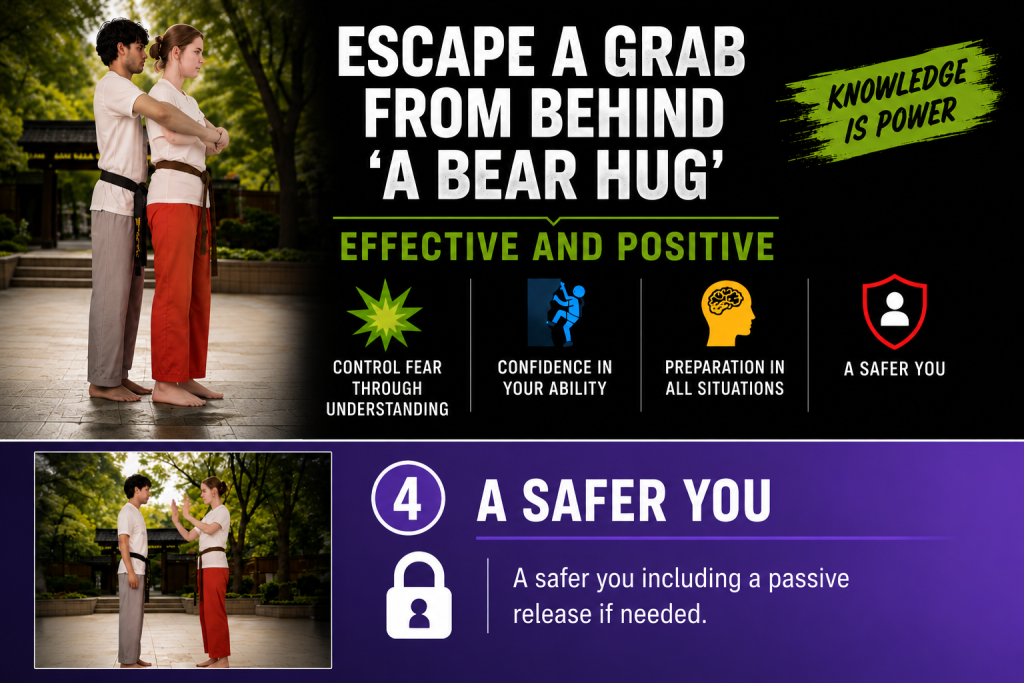
How to Practise Bear Hug Escapes Safely
If you want your responses to become more familiar, practice is essential.
Start slowly and focus on correct movement rather than speed.
Work on:
- Maintaining your balance.
- Establishing a strong base.
- Practising the movement pattern.
- Understanding how your hips and body position affect movement.
- Repeating the escape until it becomes familiar.
- Gradually introducing realistic movement with a trusted training partner.
Safety must always come first.
Communication with your training partner is particularly important.
For example, asking someone to suddenly grab you with full force may produce a very different reaction from asking them to grab lightly so you can practise the technique safely with a trusted training partner the distraction techniques get diluted due to not wanting to hurt them.
Training should develop confidence, not unnecessary injury.
Confidence Changes Everything
One of the biggest benefits of self-defence training is not aggression.
It is confidence.
Regular training can help you become more comfortable with:
- Staying calm under pressure.
- Responding to unexpected situations.
- Moving with greater confidence.
- Improving awareness.
- Making decisions when stressed.
- Understanding your physical capabilities.
Confidence does not mean believing you are unbeatable.
In fact, effective self-protection comes from understanding your limitations, recognising danger and knowing when the safest option is to leave.
The CMBBA Self Defence Mindset
At CMBBA, we believe that learning self defence is about more than learning techniques.
It is about developing a mindset.
When confronted with an unwanted physical situation, think:
Awareness → Breathe → Create an Opportunity → Escape → Get Safe
This mindset keeps the focus where it belongs.
Not on winning.
Not on looking impressive.
Not on defeating someone.
The focus is on getting home safely.
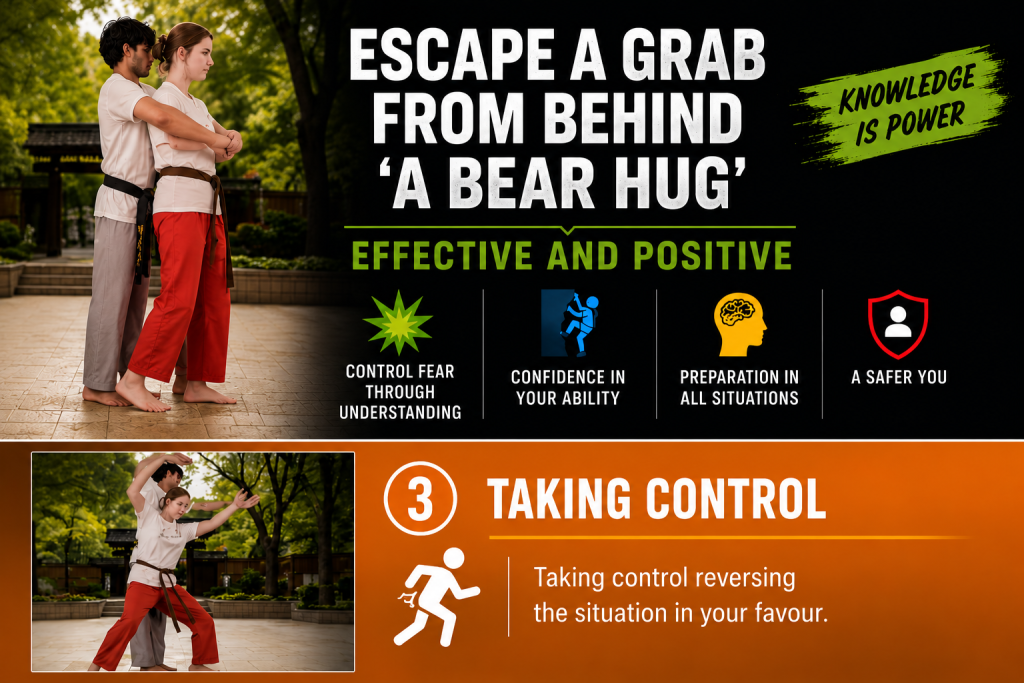
Final Thoughts: The Best Bear Hug Escape Is the One That Gets You Safely Away
A bear hug can be intimidating because it removes space, restricts movement and can affect your balance very quickly.
But being grabbed does not mean you have no options.
Learning practical bear hug self defence techniques can help you understand how balance, body position, movement and disruption can create opportunities to escape.
Remember these key principles:
- Control your breathing.
- Protect your balance.
- Lower your base when appropriate.
- Create disruption if necessary.
- Look for an opening.
- Create distance.
- Escape as soon as you can.
- Move toward safety.
The techniques covered in this article—the foot stomp and turn, elbow and separation, release-and-go principle, and base drop, hip shift and release—are not about winning a fight.
They are about creating an opportunity to regain your freedom of movement.
Real self defence is not about looking impressive. It is about staying aware, thinking clearly under pressure and giving yourself the best possible opportunity to get away safely.
Train consistently.
Practise safely.
Build your confidence.
And remember:
The best fight is the one you escape from safely.
Ready to Improve Your Self Defence Skills?
Reading about a technique is only the beginning.
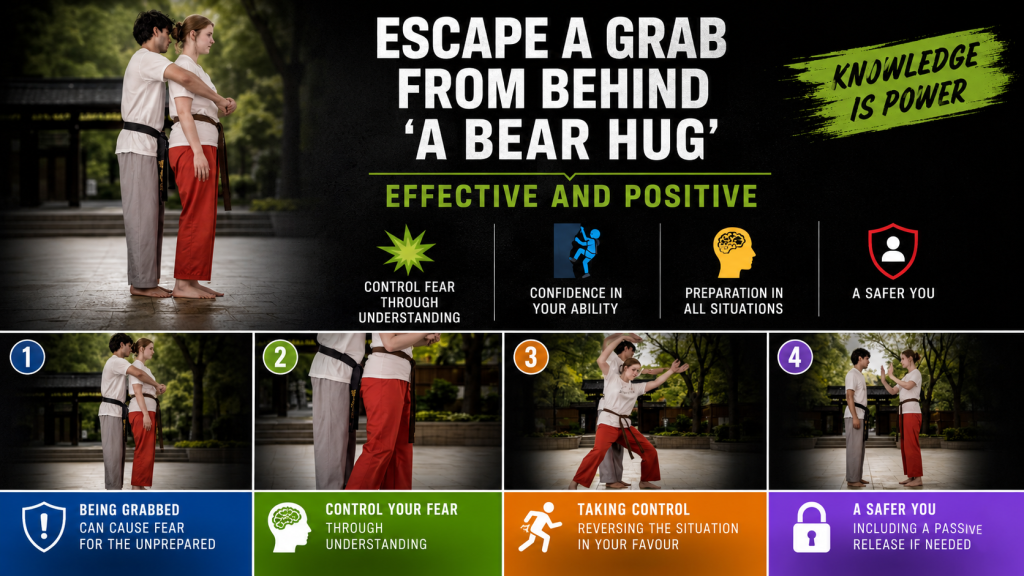
The CMBBA mini-course is designed to help you move from simply knowing what to do to actually practising the movements and developing greater confidence in your response.
Learn the technique. Practise the technique. Build the confidence to respond.