Self-defence and the fear of it
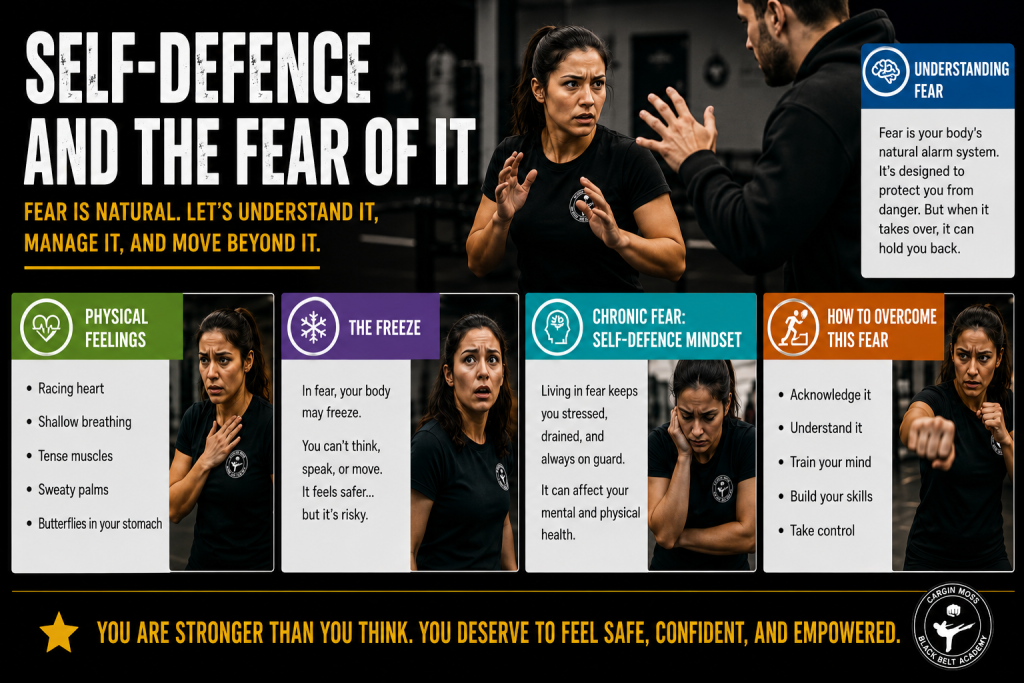
If you are in fear of verbal or physical assault then the ‘fear’ is a natural response that alerts you to the danger ahead of you. In the self-defence context, it can be a “blocker”, of movement or taking the right course of action. It will lead to panic or even freezing, which is a common statement “why am I scared to defend myself”.
The goal of self-protection is not to become a superhero but first is to manage that fear so you can stay in a mental control and make better and safe decisions.
To prevent fear
Prepare yourself and preplan your thought process in different situations, in a practical and realistic way, then you build-up stress and worry, especially when you feel uncomfortable.
The ‘fear of’ ‘what might happen’ becomes heightened by over thinking the outcomes, this will build up the feelings of anxiety and fear.
Understanding Fear
- Physical feelings: Fear triggers the “fight-or-flight” response, releasing adrenaline that increases heart rate and alertness where,
- If you do not use adrenaline which is building up, it makes the leg shake, the voice squeaky, your stomach feel uncomfortable.
- The Freeze: If the fear of a situation is unmanaged, then this can then lead to “freezing” effect, you become unable to act or think clearly.
- In some cases, people have report that they could not move, saying ‘I didn’t think it would happen to me’.
- You need to start to talk or shout, bringing normal breathing back into action and not hold your breath.
- Start to move to taking some sort of action is important, doing nothing is not the option.
- Chronic Fear: Living in constant fear can lead to paranoia and impaired decision-making. If you feel this way daily or regularly, seeking support from a mental health professional is often recommended.
There are three types of people:
Naive – It won’t happen to me, they will blindly walk into a situation without a thought, they will turn a corner as no one is there.
Paranoid – It will always happen to me, they over think that the possibility of being in, or getting into bad situations, they fear everything and everyone.
They will turn a corner with fear and anticipation that someone is there and could hurt them.
Aware – They pre plan by giving it a consideration, It could happen so they will take the corner widely as if someone want to get by.
These principles can apply to all aspects of their lives.
How to deal with your fear
Prepare mental and physical actions to help turn your fear into plans for you.
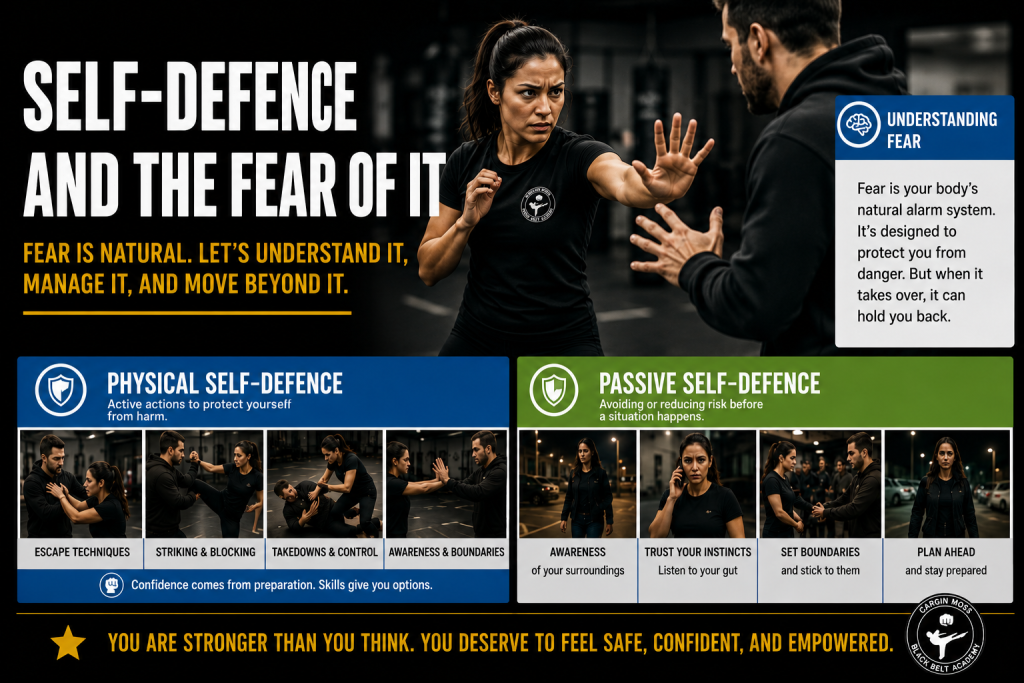
- Your situations: Be observant and aware of your surroundings and environment, working out what type of difficulties you could encounter.
- Being able to quickly scan around without looking or feeling paranoid, this will help you detect threats early.
- By doing so, you can quickly recognise the options you could take if needed before a situation becomes physical.
- Trust Your Intuition: Your “gut instinct” is your body’s warning, if something or someone feels wrong or you feel uncomfortable, then act on it immediately by leaving the place or changing your intentions there.
- Your Voice: A loud, firm command like “STOP!” or “BACK OFF!” can take someone of guard giving you a split second to back off, run or just prepare yourself.
- Controlled Breathing: Deep breathing activates (which you may have already learnt and practiced) the body’s relaxation response, helping you move from a state of panic to one of focused action.
- Talking is breathing, whether it is calm confident talking, or loud assertive commands “No thank you” “Don’t do that” “Get off me” “NO!”…. Plan some responses and drill them, keep it simple.
- Realistic Training: Practicing simple techniques in a safe, environment (like regular self-defence class or self-defence training) builds the knowledge and confidence in what you are doing, which reduces the panic of the unknown. Self-defence courses are good but if they are not regular enough then the ability gets ‘rusty’ or diluted .
- Simulaur to doing first aid training once every two-three year, you get an idea but forget the effectiveness)
Self-Defence Mindset in self-defence and the fear of it
- Believe your rights : Self-defence begins with you believing that you have the right to be safe and believe in yourself worth.
- Avoidance is Winning: The best way to not having a bad situation is to avoid it entirely. Self-defence is about getting there safely, not winning a physical contest.
- Always take the safe option, if you cut corners or taking the quickest or easy way is not always the best way.
- Being scared to defend yourself is often rooted in a fear of conflict, it can cause low self-esteem, or bring up behaviours from the past; such as being taught that speaking up leads to trouble or rejection.
This fear is a natural, involuntary response to stress (freeze response) that can be overcome by gradually practicing assertiveness, building confidence, and learning to manage confrontation.
How to overcome the fear of self-defence
- Starting point: Practice asserting yourself in low-stakes situations, such as saying “no” to small requests or expressing a preference to a trusted friend.
- Pre-plan ahead: If you expect a difficult conversation, prepare your points in advance to feel more in control and less emotional.
- Past trauma: If your fears of confrontation are linked to past abuse, professional help is a option to dealing with those fears and readjust the mindset that your voice is important and by using techniques you can make it work for you.
- Focus on your breathing and your body: In the moment, focus on breathing deeply and slowly to deal with the physical build-up of fear, try to calm yourself before you get too excited.
- Readjust your mindset: Refocus a “confrontation” as “setting boundaries” for self-protection rather than attacking someone else.
Verbal disagreement
Knowing you can disagree or debate with someone, you may not share the same views, there are certain points to keep in mind is to stay on track and respectful.
It can be that you or the other person is passionate about a certain subject, at this point keep the debate under control.
- Respect their views even if you do not agree with them.
- Try to keep the passion or tempers to a low level, once they get to a point of being over angry or over passionate then the discussion becomes where you:
- Stop listening to each other.
- Start getting more assertive if you feel you are not getting understood.
- Keep repeating the same thing as you feel you are not getting your view across.
- Start feeling angry or frustrated as you both feel you are right.
It’s at this point that you either change the approach, agree to disagree, stop the discussion, and change the subject or just step away.
Recognising conflict so you can de-escalate and ideally work on ‘conflict resolution’
The self-defence mechanism is an unconscious psychological strategy, used to protect the mind from anxiety, distressing thoughts, or threats to self-esteem.
Sometimes you need to be subtle in refocusing the conversation or at the point of saying “calm down”, which that comment, in the heighten state of an argument can cause the reaction to anger “I’M NOT ANGRY!” or “I DON”T NEED TO CALM DOWN” rephrasing the term to “let’s stop now and pick up at a later date” “Let’s agree to disagree” “Let’s take time out”.
Alternatively, re-address the conversation, if it’s a point you need to bring up opposed to a progressive conversation that goes off topic.
In the UK, self-defence is a legal justification for using reasonable and proportionate force to protect yourself or others from an immediate threat.
You do not need to wait to be attacked if a “pre-emptive strike” is permitted,if you honestly believe an attack is imminent. Key, legally tested principles include:
Legal Principles of Self-Defence
- Reasonable Force: Force must match the threat; “reasonable” depends on the circumstances as you believed them to be.
- No Duty to Retreat: You are not required to show an unwillingness to fight or to retreat before defending yourself, though doing so can show you acted in good faith.
- Imminent Threat: Self-defence applies only when responding to an immediate threat. Continuing to fight after the threat has ended is considered excessive.
- In the house: Householders are allowed ‘greater force’ against intruders in your home, which is legal unless “grossly disproportionate” you are defending your house and its residents (usually your loved one in a vulnerably situation).
- Illegal Items: It is illegal to carry any item for self-defence, including sprays, knifes, etc… in the UK.
Some common misconceptions are:
- “You must be hit first”: Incorrect. Pre-emptive action is allowed if a threat is imminent.
- “You cannot use weapons”: You can use objects immediately available (e.g., a chair to distance them etc..) to defend yourself in the heat of the moment.
- “You can fight back however you want”: If the force is disproportionate to the threat, you can be charged.
- Duty to Retreat: There is no specific legal “duty to retreat,” but if you have a safe opportunity to leave the situation and choose to fight instead opposed to just defend yourself, a court may find your use of force unreasonable.
- Defence of Others/Property: The law extends beyond personal safety; you can use reasonable force to protect another person from being attacked or to prevent a crime like burglary.
- “Heat of the Moment”: Courts recognise that you cannot “weigh to a nicety” the exact measure of force needed during an attack. If you did what you honestly and instinctively thought was necessary, it is strong evidence of lawful self-defence.
Self-Defence Items
- Illegal Weapons: In the UK, it is illegal to carry any item specifically for use as a weapon, including pepper spray, tasers, or knives…
- Legal Alternatives: Personal alarms are the only items specifically recommended for self-defence as they are legal and intended to shock an attacker and draw attention and possible give you chance to get away for yourself.
- Everyday Objects: You may use an everyday object (like keys, an umbrella, or a rolled-up magazine) to defend yourself, provided you were already carrying it for its intended purpose and the force used is reasonable.
Disclaimer: Self-defence laws are very complex and fact specific. Each a case is justified on individual situations. This information is based on general legal guidelines and should not be taken as legal advice and can vary from country to country.
Self-defence is the legal right to use reasonable force to protect yourself, others, or property from an immediate threat. It is not just about physical combat; it encompasses a layered approach starting with awareness and de-escalation.
Basic Legal Principles (UK)
- Minimal Force: You can only use as much force as is necessary and proportionate to the threat you face.
- Make it Legal: Within the bounds of the country, you live in, in the UK you can protect, yourself, your family and your home (possessions) for theft, damage and danger.
- Lawful: If it minimal and Legal then it should be lawful in the eyes of the law.
Immediate Actions for Safety
- Run/Escape: Your primary goal is to get away. Run to a safe place, such as a crowded area or a secure building.
- Hide: If escape is not possible, lock yourself in a room, turn off lights, and silence your phone.
- Tell/Call Police:
Call 999 as soon as it is safe to do so.
- If you cannot speak on a 999 call: Press 55 when prompted to transfer to the police.
- De-escalate: Use a calm, neutral tone of voice to try and lower the tension if safety allows.
Physical Self-Defence (When Necessary)
- Defend Proportionally: You are entitled to use “reasonable force” to protect yourself, meaning only what is necessary to stop the attack.
- Create Distance: Shift to a fighting stance (dominant foot back) to maintain balance and avoid being pushed over.
- Strike Vulnerable Areas: If forced to strike, target the throat, groin, or eyes to create an opportunity to escape.
- Break Grips: If grabbed from behind, try turning straight in the direction of the turn, or drop your weight, control their hands, and break free.
- Get Up Quickly: If knocked down, move into a sprinter’s stance (on one knee) to spring up quickly and run.
- Hopefully this will help you with the fear of self-defence
After the Attack
- Seek Medical Attention: Get checked for injuries, even if they seem minor.
- Report the Crime: Contact the police via 101 (non-emergency) or 999 (emergency) to report the assault.
- Seek Support: Contact Victim Support on 0808 16 89 111 for help and counselling.
- Report to Security: If the attack occurs in a building, alert security personnel immediately.
If you are physically assaulted in the UK, your priority must be safety.
Call 999 for emergencies or 101 for non-emergencies to report the crime. Seek immediate medical attention (A&E or GP) and report the assault to the police. Access free support from Victim Support on 0808 16 89 111.
Immediate Action Steps
- Ensure Safety: Move away from the attacker and get to a safe place.
- Medical Help: Get checked at A&E or a GP, even if injuries seem minor, as adrenaline can mask pain. Medical notes can serve as evidence.
- Report to Police: Call 999 if the attacker is nearby or you are in danger. Use 101 or report online if you are safe.
- Preserve Evidence: Try not to wash or change clothes until you have seen a doctor or spoken to the police.
- Witnesses: Gather contact details of anyone who saw the incident.
Support Resources
- Victim Support: Independent charity providing free, confidential support (0808 16 89 111).
- Sexual Assault Referral Centres (SARCs): Specialized support if the assault was sexual.
- Crime stoppers: To report anonymously, call 0800 555 111.
- Domestic Abuse Helpline: Call 0808 2000 247 for 24-hour support.
What to Know
- You can report an assault even without visible injuries.
- If you cannot speak on a 999 call, press 55 when prompted to alert police.
- For workplace assault, notify your manager and follow incident reporting procedures.
Self-defence and the fear of it